In short
The short answer
This guide covers rental management. Sales-side automations (leads, viewings, mandates) are covered in AI automations for real estate agencies, and choosing a provider in our comparison of AI agencies for real estate. For the sector overview, see our AI in real estate guide.
Context
The rental stock and unpaid rent in figures
An ANIL study published in April 2025 (Bail Rénov' programme, Cerema 2023 land files) counts 7,735,917 privately owned rental homes in mainland France, 73% of them flats and 51% in co-ownership buildings. Each one produces at least a rent notice and a receipt every month, which is the volume rental software sets out to absorb.
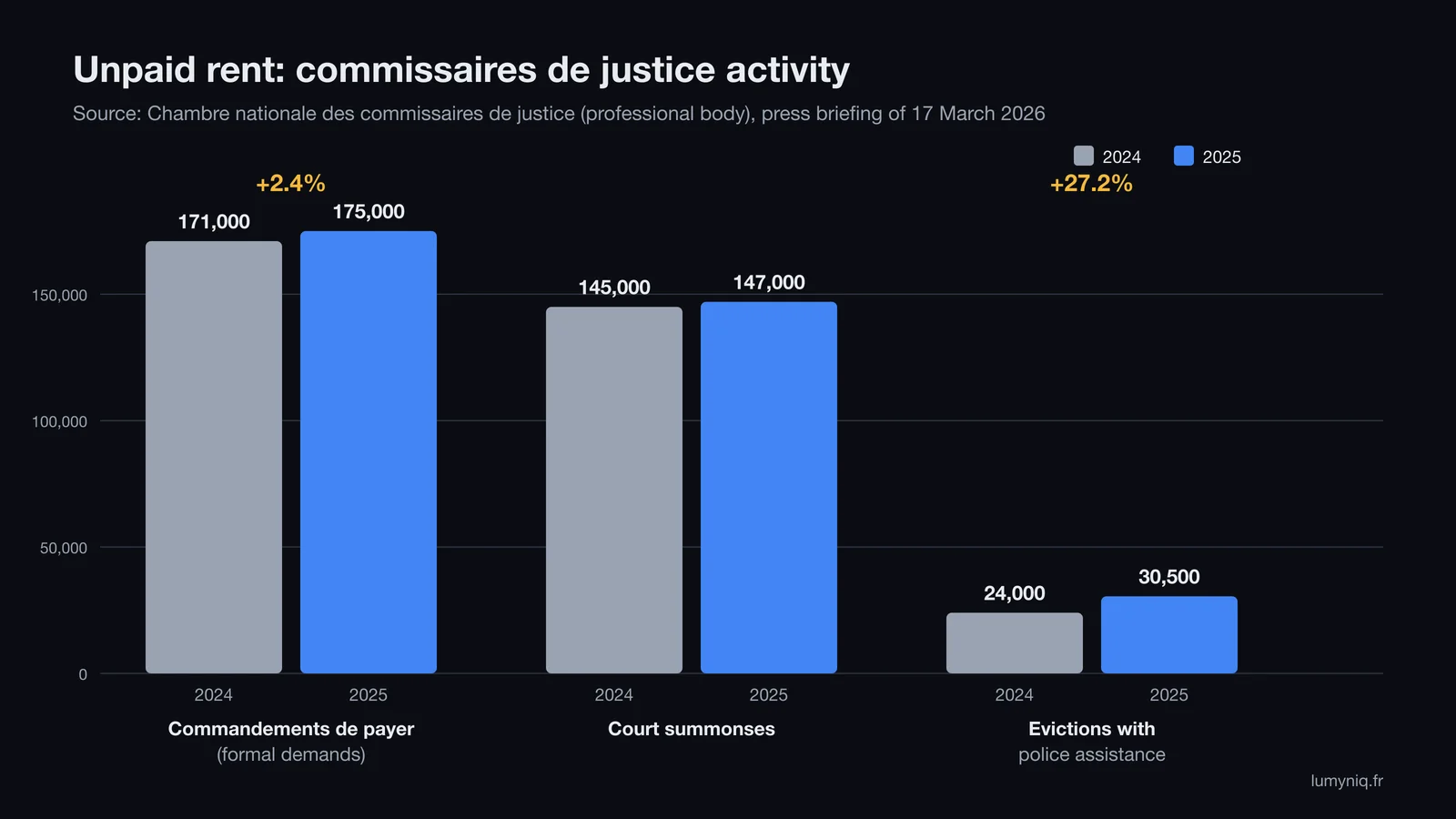
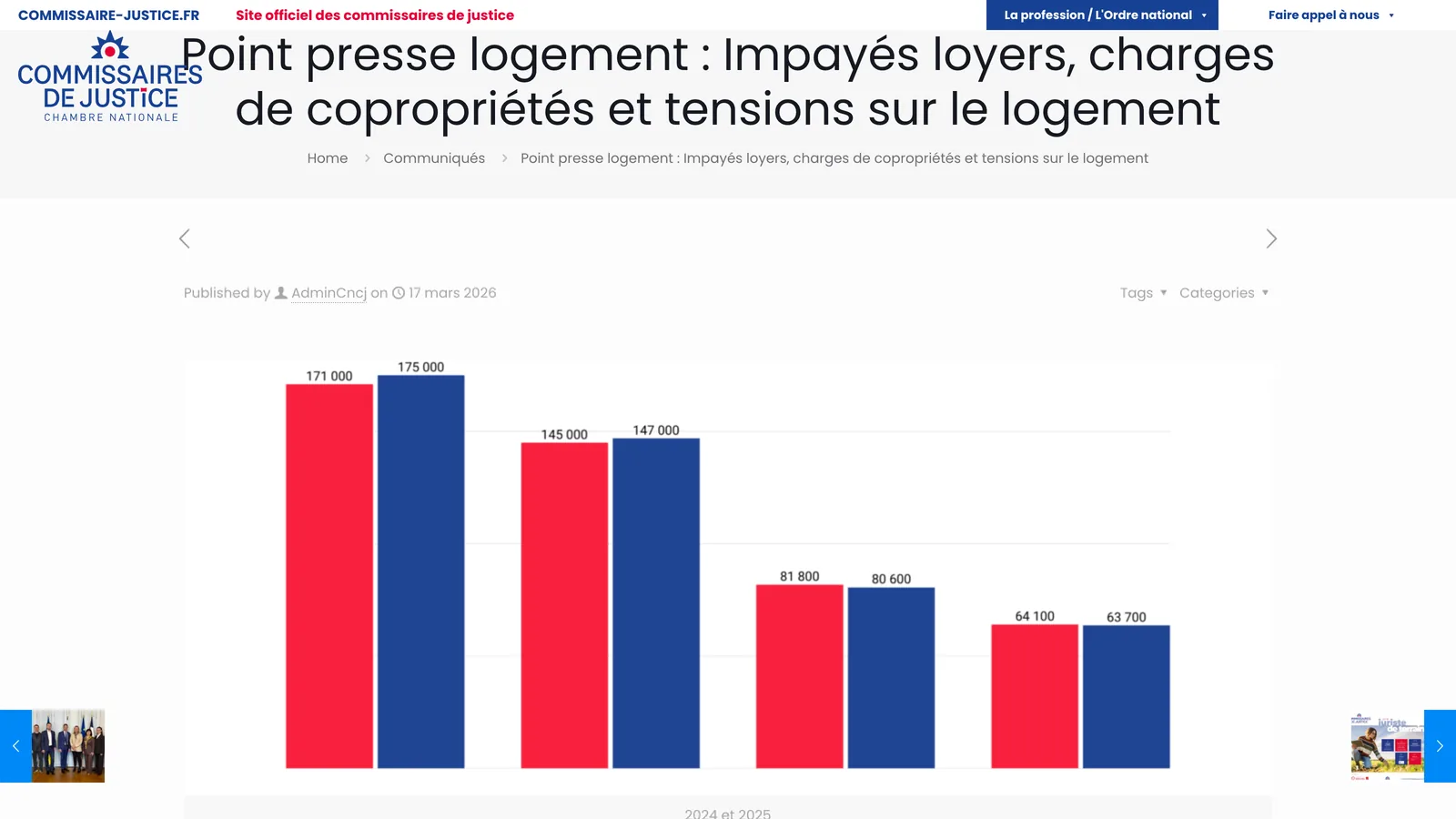
On arrears, the Chambre nationale des commissaires de justice, the profession's national body, published its figures on 17 March 2026: 175,000 commandements de payer in 2025 against 171,000 in 2024 (+2.4%), 147,000 court summonses against 145,000, and 30,500 evictions with police assistance against 24,000 (+27.2%). These figures come from the profession itself.
Overview
Process by process: what the tool does, what people keep
| Task | Automation or AI | Legal rule | Human step |
|---|---|---|---|
| Rent notice | Generated and sent on a fixed date, rent and charges calculated | No fees for managing the notice charged to the tenant (loi 89-462, art. 21) | Initial lease setup, annual rent review approved |
| Collection | Bank feed read, each rent matched | The lease cannot make direct debit the required payment method (art. 4 c) | Handling unmatched payments |
| Receipt | Quittance issued on full payment, simple receipt for partial payment | Free, itemised, electronic only with express agreement (art. 21) | Collecting the tenant’s agreement |
| Friendly reminders | Email, SMS and letter sequence with a statement | No reminder fees or penalties (art. 4 i and p); CPCE R124-4 mentions when a third party recovers | Phone call, repayment plan, decision to go formal |
| Formal notice, commandement | Draft, debt breakdown, file export | Commandement served by a commissaire de justice, 6-week deadline (art. 24-I) | Approval and signature; the commissaire’s act |
| Rental application | Completeness check, banned documents rejected, deletion scheduled | Décret 2015-1437; 3 months for rejected applicants’ solvency documents (CNIL 2021-057) | Choosing the tenant |
| Inventory report | Tablet capture, meter readings, photos, entry and exit comparison | Contents set by décret 2016-382; electronic format allowed | Inspection and signature by both parties |
| Guarantees | Visale visa dates tracked, claim deadline alerts | No guarantor on top of rent insurance, except students and apprentices (art. 22-1) | Choosing the guarantee, filing a claim |
The right-hand column marks the points where an error by the automation has a legal effect: an irregular commandement is void, and refusing an applicant on the basis of a banned document exposes the landlord to the fine in article 22-2.
1989 law, art. 21
Rent receipts and notices: what the law requires of the flow
Article 21 of the law of 6 July 1989, as amended by the ALUR law (in force since 27 March 2014), sets five rules an automatic generator has to encode:
- Free of charge: the landlord provides the quittance at no cost when the tenant asks for it.
- Itemised: rent and charges are shown separately. This is the only content the article requires.
- No management fees for the rent notice or the quittance may be charged to the tenant.
- Electronic delivery only with the tenant's express agreement. Store that dated agreement in the file, since it is what allows sending by email or through a portal.
- Partial payment: the landlord issues a receipt. The workflow therefore needs three branches: full payment (quittance), partial payment (receipt plus a reminder for the balance), no payment (reminder).
Article 4 completes the picture: a clause making automatic direct debit the required payment method is void (point c), and so is one charging the tenant for sending the quittance (point p). Software can offer direct debit as one option among others.
Collections
Bank reconciliation and open banking
Reconciliation means matching each bank statement line to an expected rent. Everything else depends on it: without reliable matching, a receipt goes out by mistake or a reminder reaches a tenant who has paid. Two methods exist: importing statements, or connecting directly to the account through an aggregator licensed under PSD2.
- Bridge states on its regulatory page that it is a payment institution licensed and supervised by the ACPR, offering account information and payment initiation.
- Powens (formerly Budget Insight) presents itself as a payment institution. Check its licence on the Banque de France REGAFI register before signing.
- Smovin says it uses Ponto and Budget Insight, now Powens, for bank sync.
Rivage claims up to 95% automated reconciliation. That is the vendor's claim, with no published method. The hard cases are well known: one transfer covering several rents, a reference that names neither tenant nor lease, payment by the CAF or a third party, a rounded amount. A language model can suggest a match from the transfer label; approving a discrepancy should stay manual. These flows handle bank data, so access control and logging matter: see our AI agent security guide.
1989 law, art. 24
Unpaid rent: the timeline and where automation fits
| Stage | What automation does | Who acts | Rule |
|---|---|---|---|
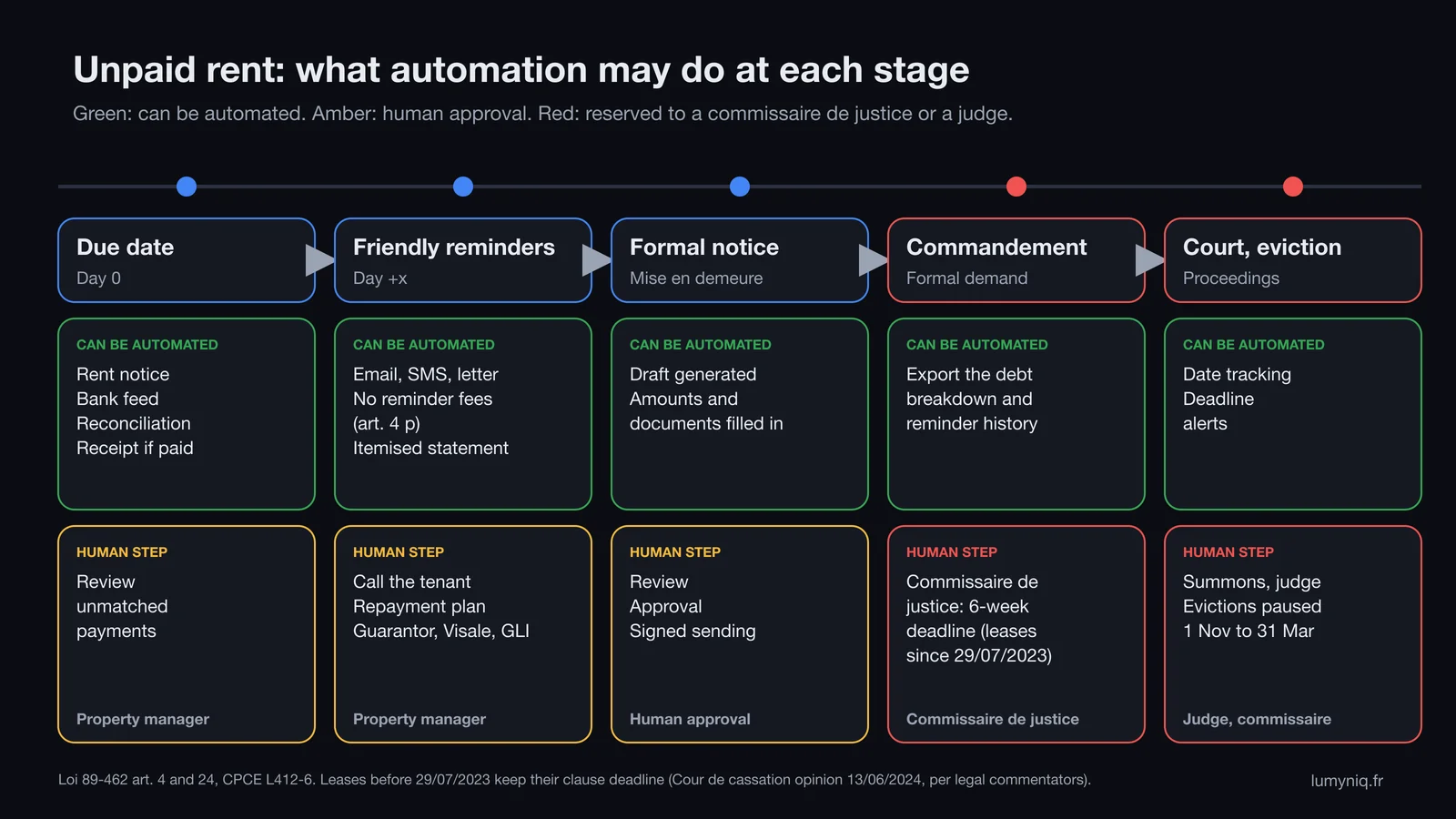
| Day 1 to day 15: friendly reminders | Detects the missing payment, sends 2 or 3 spaced reminders with a statement | Tool, then the manager by phone | No reminder fees or penalties (art. 4 i and p) |
| Formal notice (mise en demeure) | Drafts the letter and debt breakdown | Manager or landlord, after review | Customary step before formal action |
| Commandement de payer | Exports the debt breakdown, lease and reminder history | Commissaire de justice | Termination clause after 6 weeks without payment (art. 24-I, leases covered since 29/07/2023) |
| CCAPEX referral | Internal alert on the level of arrears | Commissaire de justice | From a certain level of arrears (art. 24-II, check the thresholds) |
| Summons, judgment, eviction | Date and document tracking | Judge, commissaire de justice | Evictions suspended from 1 November to 31 March (CPCE L412-6) |
The commandement de payer
Since law n° 2023-668 of 27 July 2023, in force on 29 July 2023, the termination clause takes effect six weeks after an unpaid commandement de payer (it used to be two months). The commandement must state, or it is void: the six-week deadline, the monthly rent and charges, a breakdown of the debt, a warning about possible eviction proceedings, the contact details of the housing solidarity fund (FSL) and a reference to article 1343-5 of the Civil Code on payment delays.
For leases already running on 29 July 2023, commentators on the Cour de cassation opinion of 13 June 2024 (Lexis Veille, SCPLD law firm) report that the deadline written in the lease clause still applies. Your tool therefore needs to store each lease's signature date and clause deadline instead of applying six weeks across the whole portfolio.
CCAPEX and the winter truce
From a certain level of arrears, the commissaire de justice reports the case to the CCAPEX, the departmental committee for eviction prevention. The thresholds and the landlords concerned are set by article 24-II: read it again before coding an alert. From 1 November to 31 March, article L412-6 of the Code des procédures civiles d'exécution suspends evictions unless rehousing is guaranteed. Court proceedings can continue; only enforcement is paused.
The first letter when a third party recovers the debt
Articles R124-1 and following of the CPCE govern amicable debt recovery on behalf of others. Under article R124-4, the first letter must state: who is recovering the debt, their address and that they carry out amicable recovery; the creditor's name and address; the basis and amount of the debt, broken down into principal, interest and other items; how to pay; and the text of paragraphs 2 and 3 of article L111-8. Article R124-1 excludes people acting under their own professional status or regulations. Whether a property manager holding a Hoguet card falls within that exclusion is a reading of the text, which does not say so expressly. As a precaution, build these mentions into the first reminder template.
GDPR
Tenant files: a closed list and retention periods
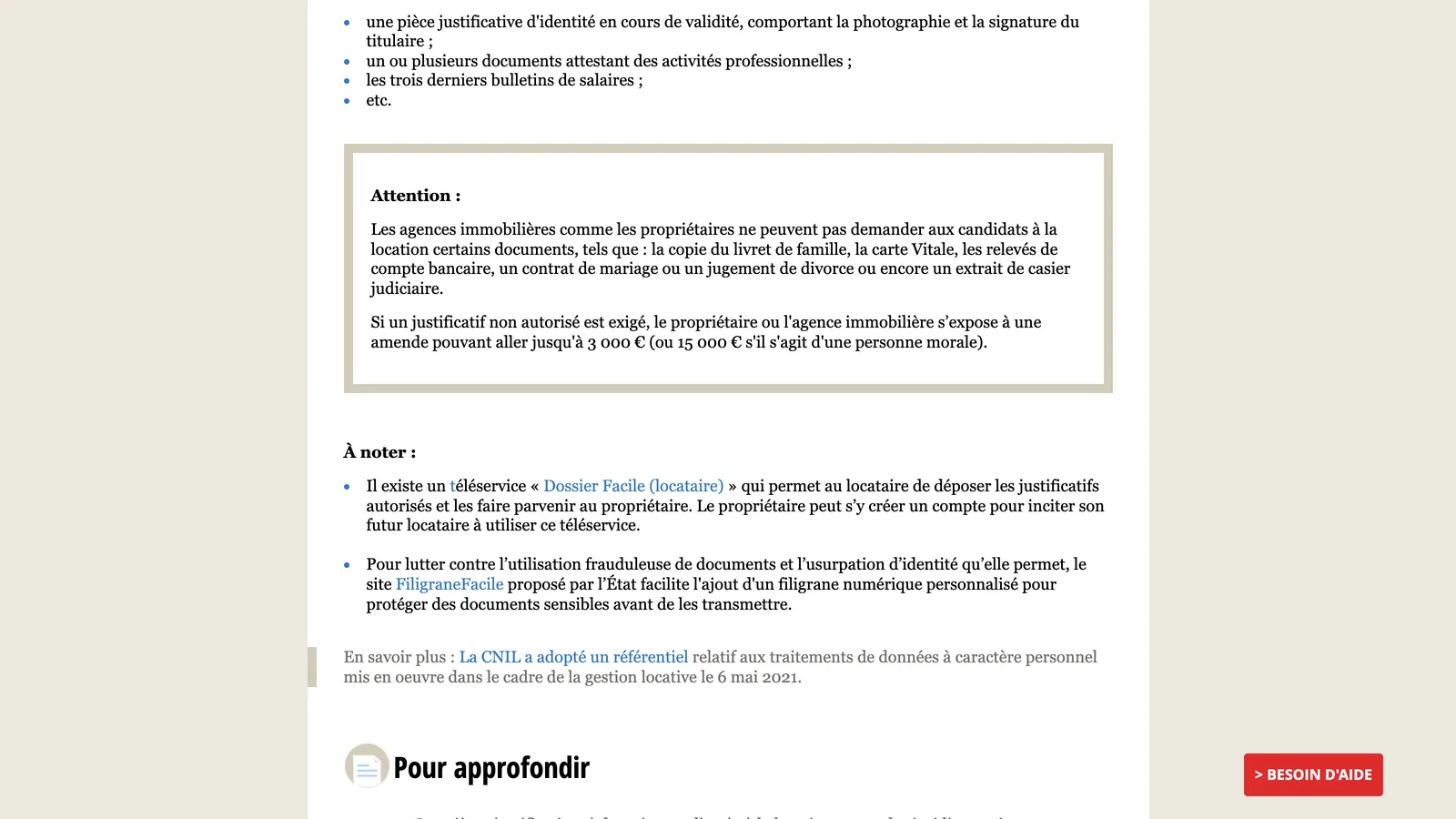
Décret n° 2015-1437 of 5 November 2015 lists the documents a landlord may request from an applicant and their guarantor: identity, address, professional activity and income. The CNIL page updated on 10 October 2025 adds that before a viewing only identity, contact details and search criteria may be collected. Among banned documents it names the family record book, the carte Vitale, bank statements, a marriage contract or divorce judgment and a criminal record extract. The administrative fine can reach €3,000 for an individual and €15,000 for a company (1989 law, art. 22-2).
| Data | Retention | Where |
|---|---|---|
| Solvency documents of a rejected applicant | 3 months | Active database |
| Prospect data | 3 years from last contact | Active database |
| Tenant data | Length of the lease, until the account is closed | Active database |
| Archives after the lease, direct management | 3 years | Intermediate archive |
| Archives after the lease, delegated or semi-delegated management | 5 years | Intermediate archive |
In practice, an AI agent reading incoming documents should file each one under a category of the decree, delete or return anything off the list, schedule deletion at three months for rejected applicants, and never make the refusal decision alone (GDPR, article 22). DossierFacile, the public service the CNIL points to, delivers documents that have already been checked. On who owns and hosts this data, see why agencies should own their data.
Décret 2016-382
Digital check-in and check-out reports: required contents
Décret n° 2016-382 of 30 March 2016, in force since 1 June 2016, lists what the app has to capture:
- whether it is an entry or exit report, and its date;
- the address of the property, and the names and addresses of the parties;
- meter readings and details of the keys;
- for each room, the condition of floors, walls, ceilings, equipment and fittings.
The exit report also needs the tenant's new address, the date of the entry report and changes since entry. The report can be on paper or electronic and is handed to each party once signed. Photos are allowed but not required, and a wear-and-tear grid from a collective agreement may be used. AI helps compare entry and exit descriptions room by room and prepares the deposit deductions, which the manager approves.
Guarantees
Guarantor, Visale, rent insurance: what the workflow should check
No stacking. Since 1 January 2022, article 22-1 of the 1989 law bars a landlord covered by rent insurance or another rent guarantee from also requiring a guarantor, or the guarantee is void, unless the tenant is a student or apprentice. This is a simple rule to encode when the file is built.
Visale in 2026. According to Que Choisir (4 February 2026) and Galian (12 February 2026), the scheme changed on 6 January 2026; the visale.fr site could not be reached to confirm. Per those sources: it remains free, 18 to 30 year olds qualify with no income condition, the income ceiling for employees over 30 rises to €1,710 net per month, and rent is capped at €1,940 in zone 1, €1,575 in zone 2 and €1,365 in zone 3 for non-students. In private housing, unpaid rent cover runs up to 36 months and only during the first 3 years of occupancy. The visa must be obtained no later than the day the lease is signed, and Visale cannot be combined with another guarantee. For automation, that means an alert before the covered period ends and a block if the visa date is after the lease date.
Rent insurance (GLI). The garantie des loyers impayés is taken out by the landlord, individually or through the agency's group policy. Insurers set their own eligibility criteria and claim deadlines, and it is those contractual deadlines the workflow has to track, policy by policy.
Loi Hoguet
Who may manage property: the licence stays with a person
Managing property for others requires the professional card under law n° 70-9 of 2 January 1970 (article 3): proven professional ability, a financial guarantee for client funds, professional liability insurance and a clean record. Article 6 requires a written mandate stating how fees are paid and how funds are handled. Décret n° 2016-173 of 18 February 2016 sets continuing education at 14 hours a year, or 42 hours over three consecutive years, with a non-discrimination module added by décret n° 2020-1259.
Two practical consequences: automated payouts to owners must follow the terms of the mandate, and no software or AI agent lets someone without a card manage property on behalf of others.
The market
Rental management software and its automation
| Software | For | Automation on the official page | Public price |
|---|---|---|---|
| Septeo SPI Gestion Locative | Property managers (administrateurs de biens) | Rent billing, reminders, GLI, owner payouts, invoice OCR, configurable scenarios; "950,000+ units managed" per the vendor | Not published |
| Rivage | Agencies, family offices, co-living, social housing | Invoice and IBAN recognition, bank reconciliation "up to 95%" per the vendor, rent calls and receipts, AI assistant, API, n8n, Make, Pennylane | Not published |
| Rentila | Individual landlords | Automatic receipts and reminders, bank sync, AI assistant | Free (1 property); Silver €5.90/month or €59/year; Gold €11.90/month or €119/year |
| Qalimo | Landlords, plus custom Business and Agency plans | Bank sync, automatic arrears reminders, digital inventory with photos | €4.90 per property/month (1 to 7); €34.30/month (7 to 40); custom above |
| BailFacile | Individual landlords | Automatic receipts and rent reviews, smartphone inventory reports | Not recorded |
| Smovin | Belgium and France | Rent indexation, automatic reminders, charge reconciliation, PSD2 bank sync via Ponto and Powens | Not shown |
Software for individual landlords handles receipts and reminders well. A professional manager usually needs more: linking rental management to the CRM, the phone system, accounting or the rent insurer. That is where a custom workflow or an open CRM such as Twenty comes in.
Design
Example workflow: from bank feed to approved reminder
A typical design, buildable with n8n on top of the existing management software:
- Bank feed: every morning, fetch transactions through the PSD2 aggregator or import the statement.
- Reconciliation: exact match on amount and reference; for ambiguous labels, a language model suggests a tenant with a confidence score, and anything below the threshold goes to a review queue.
- Paid branch: quittance for full payment, receipt for partial payment, sent electronically only if express agreement is on file.
- Unpaid branch: friendly reminders with no fees, controlled wording (no penalties, R124-4 mentions if a third party recovers), stopping automatically as soon as payment arrives.
- Human approval before any formal notice or handover to a commissaire de justice: the manager gets the debt breakdown and history and clicks to approve.
- Log: every message, agreement and decision is written to the CRM with its date, which serves as evidence if the tenant disputes it.
Workflows of this kind, sector by sector, are described in our n8n workflow examples by sector. For hosting and maintaining n8n, see our n8n agency page.
AI Act
Tenant-facing chatbots: the transparency duty
An agent answering tenants (certificate requests, repair reports, balance questions) has been subject since 2 August 2026 to article 50 of Regulation (EU) 2024/1689, as amended by Regulation (EU) 2026/1744: people must know they are dealing with AI, at the latest at the first interaction. The details are in our guide to the AI agent transparency obligation.
An AI-computed solvency score for applicants might fall under Annex III (high risk, applicable from 2 December 2027); whether rental screening is covered is not settled. Until it is, keep AI to checking that files are complete and compliant.
Lumyniq, an AI automation agency based in Paris, builds n8n workflows, custom AI agents and CRM integrations for property managers and agencies. Every project starts with an audit of the process in scope before any quote.
FAQ