In brief
The short answer
This guide covers the rules and the data flow. Software is compared in the best legal AI tools, and uses by type of firm in our AI for the legal sector guide.
Timeline
The profession's texts on AI, by date
Between September 2024 and July 2026, the profession's bodies published six documents on AI, and the EU regulation adds its own deadlines. None of the professional texts creates a new obligation: they apply the existing rules on secrecy, competence and prudence to AI.
| Date | Text | Author | Status |
|---|---|---|---|
| September 2024 | Guide on the use of generative AI systems, 1st edition | CNB | Practical guide |
| 2 June 2025 | Assessment grid for AI tools: data sovereignty and security, features, ethics, cost | CNB | Vendor assessment tool |
| 2 October 2025 | Guide on the use of generative AI by lawyers (secrecy, competence, independence, client information, conflicts of interest) | CCBE | European recommendations |
| 24 October 2025 | Guide on generative AI and ethical vigilance for judges and lawyers | Joint advisory council on judge-lawyer ethics, released by the Cour de cassation | Date from the Jus Mundi database; official page not opened |
| 12 and 13 March 2026 | "La déontologie et l’intelligence artificielle" guide, adopted at the general assembly | CNB, rules and practice committee | Operational guide |
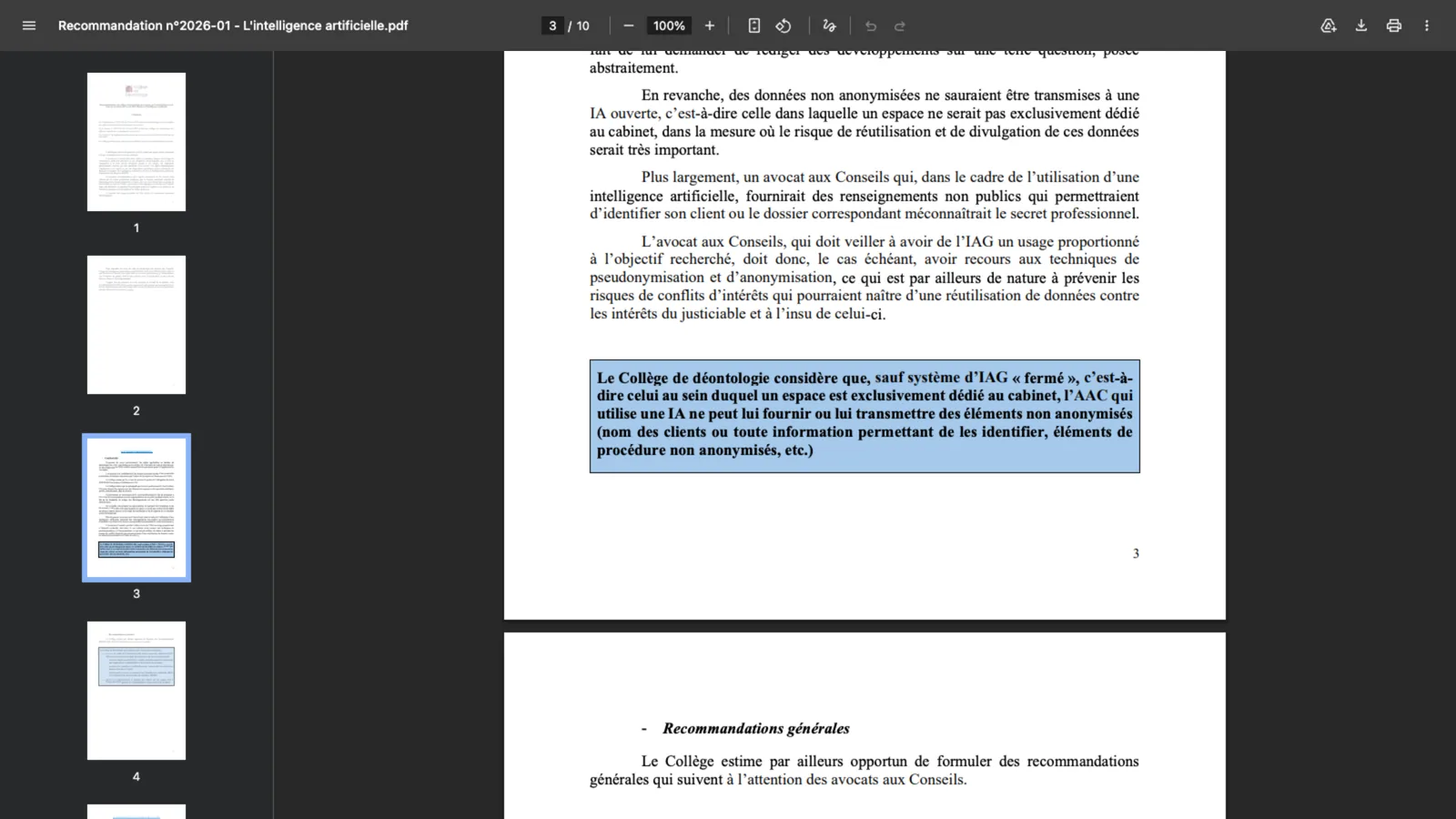
| 2 April 2026 | Recommendation no. 2026-01 on artificial intelligence | Collège de déontologie of the lawyers at the Conseil d’État and Cour de cassation | Ethics recommendation |
| 13 April 2026 (CNB page) | Optional AI clause in the model fee agreements, voted at the March assembly | CNB | Contract template |
| 21 July 2026 | Model AI usage charter for firms, published on 23 July | Conseil de l’Ordre, Paris bar | Not binding, adoption optional |
| 27 July 2026 | Regulation (EU) 2026/1744 (Digital Omnibus) amending the AI Act enters into force | European Union | Amends Article 4 among others |
| 2 August 2026 | AI Act Article 50: transparency for systems that interact with people | European Union | Legal obligation |
| 2 December 2027 | Annex III high-risk rules apply | European Union | Legal obligation |
The public version of the 2026 guide is listed in the CNB's practical guides. Alongside it, the CNB and Lefebvre Dalloz run free online training on the Skilia platform until 2027; the CNB reported 10,000 sign-ups in its first two months (June 2025).
Legal basis
What French lawyers' professional secrecy rests on
Three texts apply to any use of AI that touches a case file.
- Article 66-5 of Law no. 71-1130 of 31 December 1971: in all matters, advisory and litigation, secrecy covers consultations sent to the client, correspondence with the client, correspondence between lawyers (unless marked "officielle"), meeting notes and every document in the file. Current version in force since 30 March 2011.
- Article 2 of the Règlement intérieur national (RIN): secrecy is a matter of public policy, general, absolute and unlimited in time. It also covers client names, the diary and financial settlements. The lawyer must ensure that staff and anyone working with them respect it, and answers for their breaches (Article 2.3).
- Article 226-13 of the French Criminal Code: disclosing secret information held by profession is punishable by one year in prison and a €15,000 fine.
Article 2.3 of the RIN is the hook for AI vendors. A provider that receives the content of a file is in practice working with the lawyer, who answers for what that provider does with the data. That is why the contract, the retention period and the no-training commitment, covered below, matter.
In practice
What each text asks for
The CNB guide (March 2026)
The full text is long and its first version was reserved for lawyers. According to the CNB's announcement, it covers four blocks: professional secrecy and the GDPR; competence, prudence and independence; informing the client; balanced fees. The CNB describes it as an operational guide with risks, good practice, recommendations and recent case law. Its assessment grid of June 2025 remains the most practical way to compare vendors.
Collège de déontologie AAC recommendation no. 2026-01 (2 April 2026)
This is the clearest text on data. It is addressed to lawyers at the Conseil d'État and the Cour de cassation, but its reasoning starts from professional secrecy, so the grid carries over readily to any French firm. Its main points:
- asking an AI to handle a legal question put in abstract terms does not breach secrecy;
- except in a closed AI system, where a space is reserved exclusively for the firm, no non-anonymised data may be given to it: client names, information that identifies them, procedural details;
- use pseudonymisation and anonymisation where needed;
- assess tools: terms of use, compliance with the AI Act and the GDPR;
- warn staff and get trained;
- always check the outputs;
- the lawyer's responsibility is the same whether or not AI was used.
The Paris bar model charter (21 July 2026)
Adopted by the Conseil de l'Ordre as part of its "Vers un barreau souverain" strategy, the model can be downloaded as a Word file and each firm decides whether to adopt it. It sets five principles: professional secrecy is an absolute limit; no confidential data is sent without sufficient safeguards; human control applies at every stage; the lawyer remains responsible; the choice of tool and hosting needs particular care.
The AI clause in fee agreements
The same CNB assembly in March 2026 added an optional clause to the model fee agreements. It presents AI as technical assistance, states that analysis and responsibility remain human, covers confidentiality and warns the client against pasting the lawyer's work into non-secure AI tools. It is the simplest way to inform clients.
Case law
French decisions on invented case law
Since December 2025, several French courts have flagged AI-generated references that do not exist. The first ones concerned parties without a lawyer; later ones address lawyers directly.
| Court and date | What was found | Addressed to |
|---|---|---|
| TA Grenoble, 3 and 9 December 2025 (no. 2509827 and 2512468) | Fanciful references in filings drafted with generative AI, one still containing the chat conversation | Parties without a lawyer |
| TJ Périgueux, 18 December 2025 (RG 23/00452, social division) | First judicial court to name AI "hallucinations" | The claimant and their lawyer, told to check their references |
| TA Orléans, 29 December 2025 (no. 2506461) | About 15 of 17 citations non-existent or irrelevant (Conseil d’État, CNDA, CAA) | The lawyer, told to check references are not hallucinations |
| TA Rennes, 28 January 2026 (no. 2506364) | Petition clearly written with AI, dismissed | Petitioner |
| CAA Bordeaux, 26 February 2026 (no. 25BX02906) | Repeated the hallucination warning | Not specified in the sources consulted |
Sanctions. To our knowledge, there is no published disciplinary sanction against a French lawyer as of 13 September 2026, according to a review of 159 decisions (Judilibre and Légifrance) published by the firm Kohen Avocats. The same review reports a €200 fine imposed by TA Grenoble on 4 June 2026 (no. 2410230) on a party without a lawyer, where invented references were one factor among others. This review is a single source.
The practical consequence is the same in every text: any reference produced by AI is checked in an official database before it goes into a filing.
CNB Observatoire
French lawyers and AI in figures
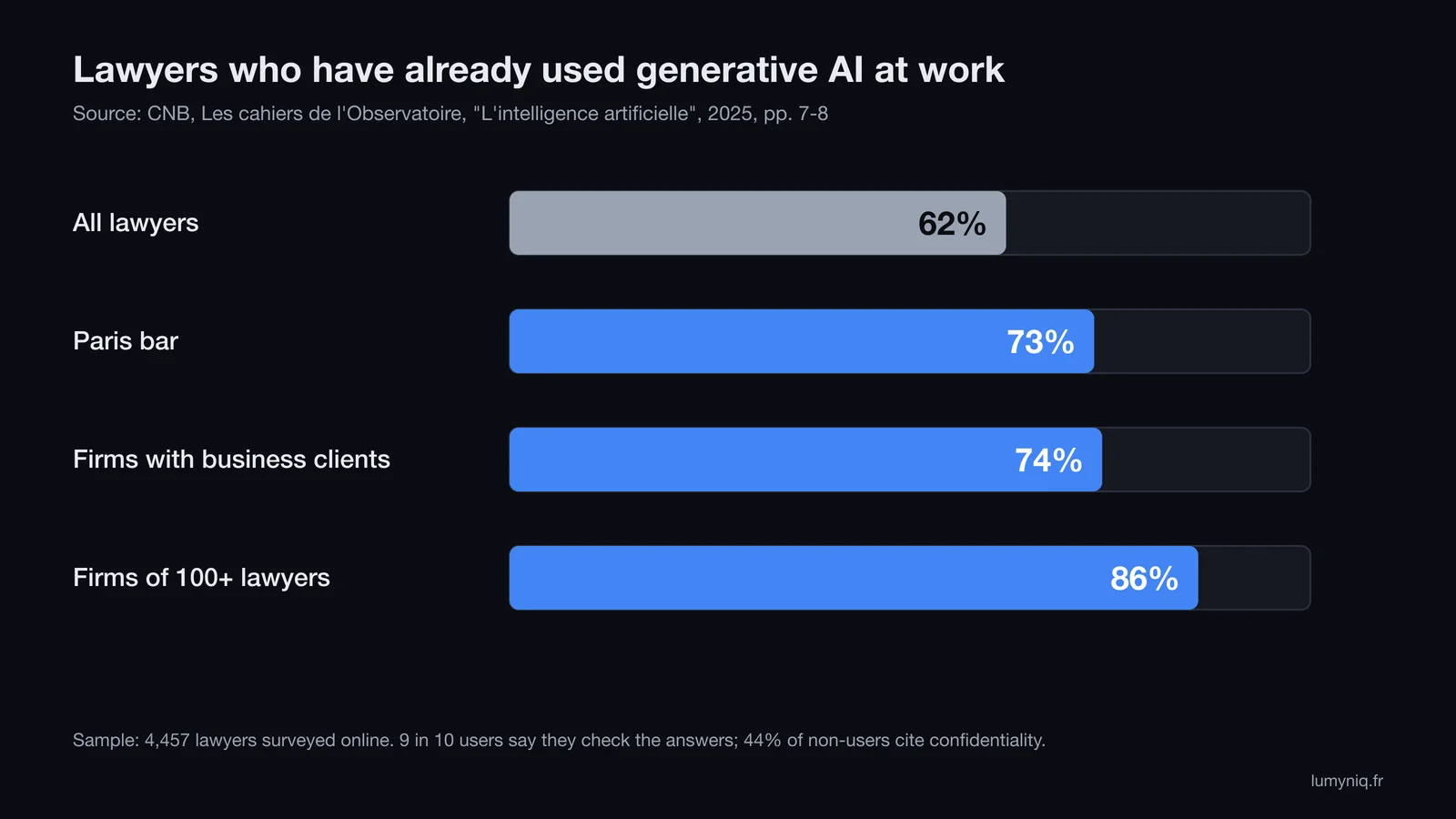
The CNB Observatoire report on AI (2025, produced with Viavoice and Les Temps Nouveaux) is based on 4,457 lawyers surveyed online, plus samples of French adults, individual clients, businesses and the public sector.
| Indicator | Value | Page |
|---|---|---|
| Lawyers who have used generative AI at work | 62% (28% plan to) | p. 7 |
| Lawyers who trust generative AI to protect data | 1 in 10 | p. 15 |
| Users who say they check the answers | 9 in 10 | p. 16 |
| Non-users citing confidentiality | 44% (70% cite lack of trust in the results) | p. 18 |
| Firms using AI: general and legal tools | 53% both, 23% general only, 21% legal only | p. 11 |
| Trust among users | 34% in general tools, 54% in legal tools | p. 11 |
The gap between 62% usage and 1 lawyer in 10 trusting AI with data sums up the problem: the profession uses these tools without having settled where case files go. The architecture section below addresses that.
GDPR
GDPR: pseudonymisation is not enough
According to secondary sources, the CNB's 2024 guide advised pseudonymising data (names, addresses) before submitting it to an AI. That helps with secrecy, but the CNIL states that pseudonymised data remain personal data: pseudonymisation can be reversed. Only anonymisation takes data outside the GDPR, and the CNIL tests it on three criteria: singling out, linkability, inference. A detailed litigation file rarely passes all three.
- Data minimisation: send only data that is adequate, relevant and limited to the task. The CNIL applies this to AI systems in its recommendations of 7 February 2025.
- Processing agreement (GDPR Article 28) with every provider that handles file data, and standard contractual clauses (Article 46) for any transfer outside the EU.
- No CNIL page specific to lawyers: as of 15 September 2026 we found no CNIL guidance dedicated to lawyers using AI. The general AI recommendations apply.
Published court decisions are a different case: Decree no. 2020-797 of 29 June 2020 requires the names of natural persons to be hidden in open data. Working on those decisions falls under level 1 of the architecture below.
AI Act
What the AI Act covers in a law firm, and what it does not
- Article 4, AI literacy: in application since 2 February 2025, softened by Regulation (EU) 2026/1744, in force since 27 July 2026. Providers and deployers must now take measures to support the AI literacy of their staff. A firm that deploys a tool is still covered.
- Article 50(1), transparency: since 2 August 2026, people must be told they are dealing with an AI unless it is obvious. An intake or pre-qualification chatbot on a firm's website is covered. See the transparency obligation for AI agents.
- Annex III, point 8(a): it covers systems used by or on behalf of a judicial authority, or in a similar way in alternative dispute resolution. A firm's research, drafting or intake tools are not high-risk on that basis. Annex III rules apply from 2 December 2027.
The full timeline is in our AI Act guide for businesses.
Architecture
Which data goes to which tool: a three-level architecture
Recommendation no. 2026-01 gives the sorting criterion: what the prompt contains. We derive three levels from it, each with a different technical route.
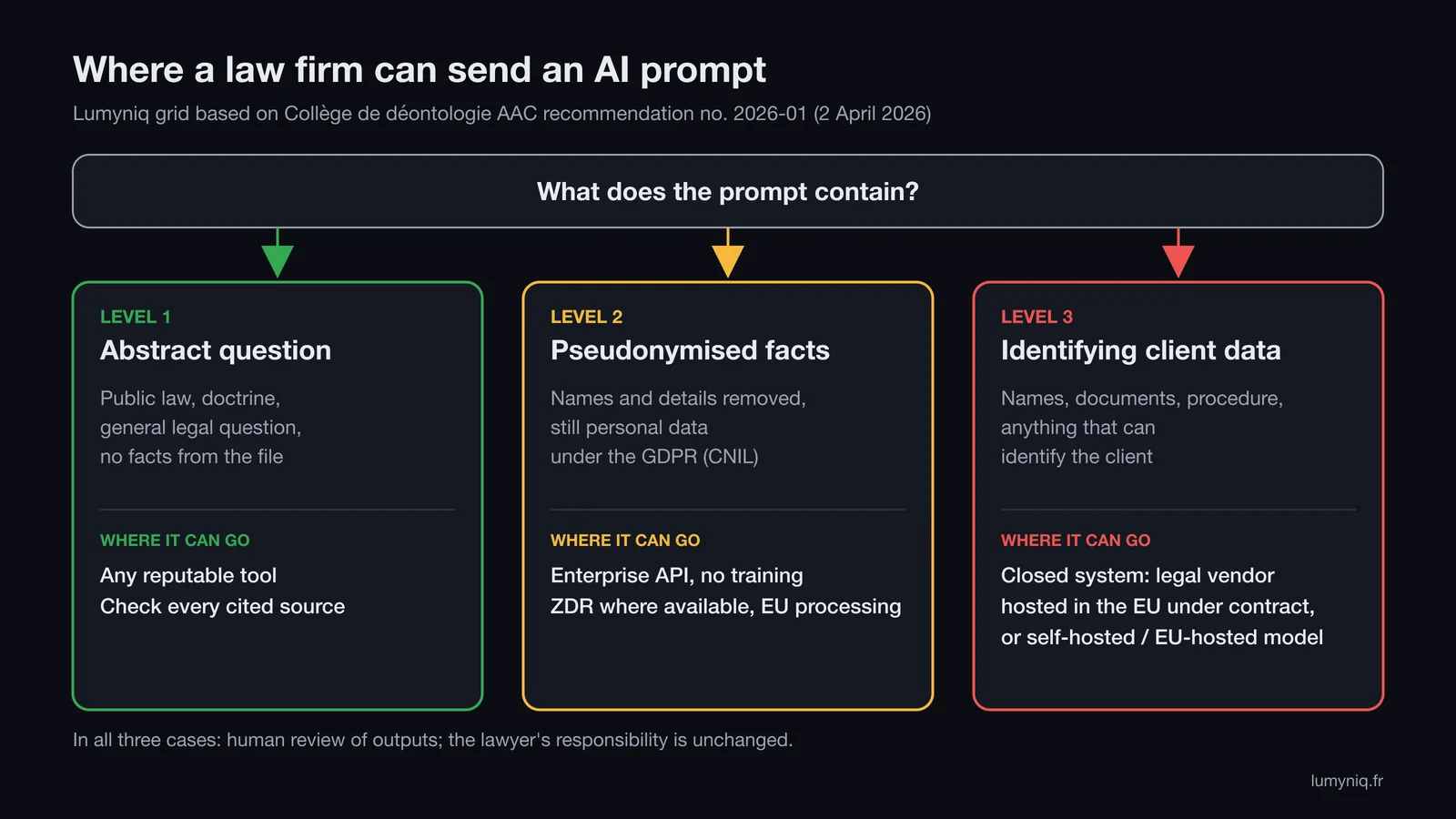
Level 1: abstract questions and public law
General legal questions, research on published texts, analysis of already-redacted decisions: no facts from the file. Any reputable tool will do, including a general assistant. The constraint is checking every cited source, given the decisions above.
Level 2: pseudonymised facts
A summary of facts without names or identifying details is still personal data. It goes through an enterprise plan or an API under contract, with no training on the data, zero data retention (ZDR) where available and processing in the EU.
Level 3: identifying client data
Names, exhibits, pleadings, procedural details: only in a closed system as the recommendation defines it. In practice, a legal vendor hosting in the EU under contract, or a model that is self-hosted or deployed in a European cloud region, with a space reserved for the firm. To query a firm's documents without exposing them, see RAG for businesses.
| Model provider | EU processing | Zero data retention (ZDR) | Training |
|---|---|---|---|
| Anthropic (direct Claude API) | No: "us" or "global" inference, stored data in the US. EU region via Amazon Bedrock or Google Cloud | On request, per organisation. Claude Team and Enterprise not eligible | Not without permission |
| OpenAI (API) | Europe residency (EEA and Switzerland) subject to approval and a contract amendment | Possible on chat/completions, responses, embeddings; not on assistants, threads or conversations. Otherwise abuse-monitoring logs up to 30 days | Not on API data since 1 March 2023 |
| Mistral | EU hosting by default; some features may transfer outside the EU under SCCs, can be switched off on Enterprise | On request, pay-as-you-go stateless API only; not for Chat, agents or batch | Enterprise opted out by default |
An EU-only route on Claude therefore means Bedrock or Google Cloud in an EU region, or choosing Mistral. Differences between assistants are covered in Claude vs ChatGPT for business, and the technical set-up on our Claude integration page.
Vendors
Hosting and data: what legal AI vendors publish
This table is limited to hosting and data-handling facts verified on vendor pages. Features and plans are compared in our legal AI tools comparison.
| Tool | Hosting and data | Other verified facts |
|---|---|---|
| Doctrine | Servers in Frankfurt (EU), no transfers outside the EU, ISO 27001 since 2025, no training on customer data, AES-256 encryption | Acquisition of Predictice announced 17 September 2025, being merged into Doctrine |
| GenIA-L (Lefebvre Dalloz) | Hosted in Europe only (infrastructure, application, model), on AWS EMEA SARL; queries and answers neither kept nor used for training | GDPR and AI Act compliance claimed by the vendor (undated page) |
| Harvey | No training on customer data; requires zero data retention from all its model providers. Hosting location not stated in the pages read | Paris office opened 11 May 2026. Named clients: Bredin Prat, CMS Francis Lefebvre, August Debouzy, Berenice Avocats, Chassany Watrelot & Associés |
| Ordalie | Application and models hosted in France according to the vendor; SOC 2 and ISO 27001; no retention by model providers | Named clients: Carlini Avocats, Gouache Avocats |
| Legora | No training on customer data; SOC 2 Type II, ISO 27001, ISO 42001 | Technical team in Sweden; no French clients or Paris office on the homepage |
| Jimini | Hosting location not stated on the website | Claims 10,000+ users including Gide, FTPA and Hoche Avocats; 2-week trial |
A certification or French hosting does not replace the contract: ask for the DPA, the list of sub-processors and the retention period, then compare against the CNB assessment grid.
Before you sign
A law firm's checklist before deploying an AI tool
- CNB grid: assess the tool on the four axes of the June 2025 grid (data, features, ethics, cost).
- Processing agreement compliant with GDPR Article 28, with the list of sub-processors.
- Hosting: storage country and inference country in writing, plus standard contractual clauses for any transfer.
- Retention: how long prompts and answers are kept, and zero retention where available.
- Training: a contractual exclusion of training on the firm's data.
- Access control: a space reserved for the firm, per-matter permissions, strong authentication.
- Logs: who sent what, and how long logs are kept.
- Staff training: measures under AI Act Article 4, and written rules on the three data levels, for lawyers and assistants alike (RIN Article 2.3).
- Client information: an AI clause in the fee agreement, based on the CNB model.
- Verification procedure: who checks each output, against which official database, before anything is sent or filed.
Technical safeguards (isolation, prompt injection, logging) are covered in our guide on AI agent security.
Decision
Buy a legal AI tool or build a custom one
| Need | Best fit | Why |
|---|---|---|
| Legal research and case law | Buy: Doctrine, GenIA-L or similar | The vendor maintains the document base and cited sources; EU hosting documented |
| Analysis and drafting from case documents | Buy a legal tool, or a custom closed space | Depends on volume and hosting requirements; check level 3 |
| Pre-qualification of incoming enquiries | Custom | Questions specific to the firm’s practice areas, Article 50 disclosure, hand-off to the firm’s calendar and software |
| Document workflows connected to the practice management tool | Custom | Matter opening, reminders, filing of documents: they depend on the tools already in place |
| Occasional abstract questions | General assistant on an enterprise plan | Level 1, no facts from the file |
An example of a custom flow is described on our legal pre-qualification assistant page, and the general approach in custom AI agents.
Lumyniq is an AI automation agency based in Paris. It designs custom AI agents, Claude integrations and n8n workflows, including for law firms: enquiry pre-qualification and document handling connected to the firm's software. Every project starts with an audit of the process and the data flow, before any quote.
FAQ