In brief
The short answer
The cross-sector explanation of Article 50 is in our guide to the AI agent transparency obligation. This page starts from the cases an agency handles every week and the text that applies to each, including the French law that sits on top of it: misleading commercial practices, energy rating notices in listings, and the GDPR.
2 Aug 2026
Article 50 applies to all systems, with no delay for the visible label
Guidelines C(2026) 5054, para 153, 20 July 2026
2 Dec 2026
End of the vendors’ grace period for machine-readable marking (Article 50(2))
Commission AI Act Service Desk, timeline
€15M or 3%
Maximum fine for breaching Article 50; for an SME, the lower of the two
Article 99(4), restated in para 152 of the guidelines
2 Dec 2027
Annex III high risk, including the creditworthiness of natural persons
Regulation (EU) 2026/1744, Commission timeline
The grid
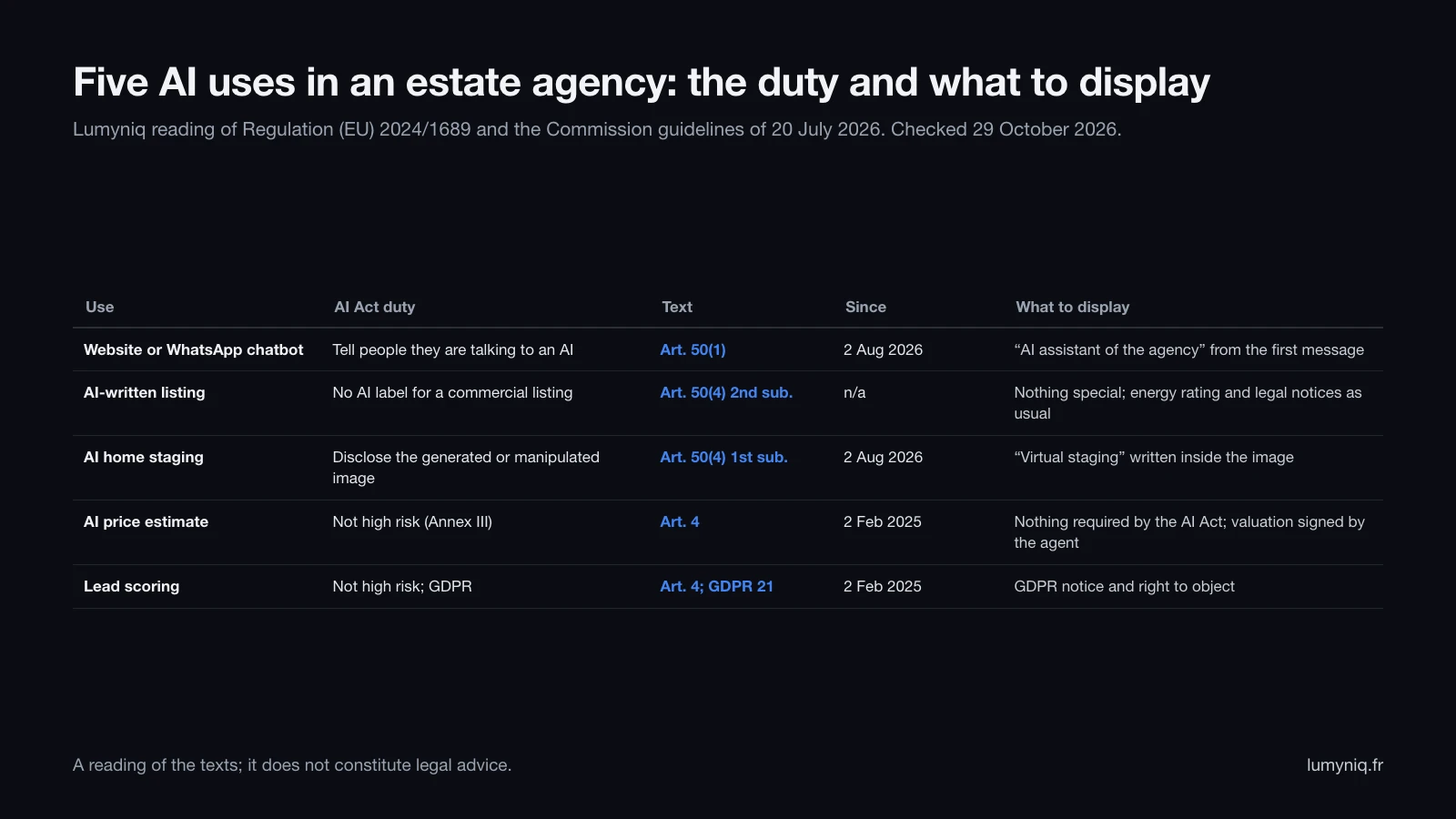
Use by use: the duty, the article, the date, the display
| Use | AI Act duty | Article | Since | What to display |
|---|---|---|---|---|
| Website, WhatsApp or Messenger chatbot | Tell the person they are dealing with an AI, unless it is obvious | 50(1) and 50(5) | 2 August 2026 | "I am the agency’s AI assistant" in the first message, and an honest answer to "are you human?" |
| AI-written listing | None: advertising text does not inform the public on a matter of public interest | 50(4), 2nd subpara (out of scope) | n/a | Nothing under the AI Act. Energy rating notices and accurate facts remain mandatory |
| AI home staging photo | Disclose the generated or manipulated image if it could pass for real | 3(60), 50(4) 1st subpara, 50(5) | 2 August 2026 | "Virtual staging, AI-generated image" written inside the image, visible on the thumbnail |
| AI price estimate | Not high risk. Article 50(1) only if the estimate happens in a conversation | 4; Annex III (out of scope) | 2 February 2025 | Nothing required by the AI Act. The valuation stays signed and owned by the agent |
| Scoring seller or buyer leads | Not high risk. GDPR: profiling for direct marketing | 4; GDPR Art. 13, 21 | 2 February 2025 | Profiling disclosed in the privacy notice, right to object |
| Scoring rental applicants | Possible high risk if the tool assesses creditworthiness | Annex III 5(b); GDPR Art. 22 | 2 December 2027 (AI Act); now (GDPR) | Final human decision, applicant informed, documents limited to French decree n° 2015-1437 |
The dates
Which dates apply to an estate agency?
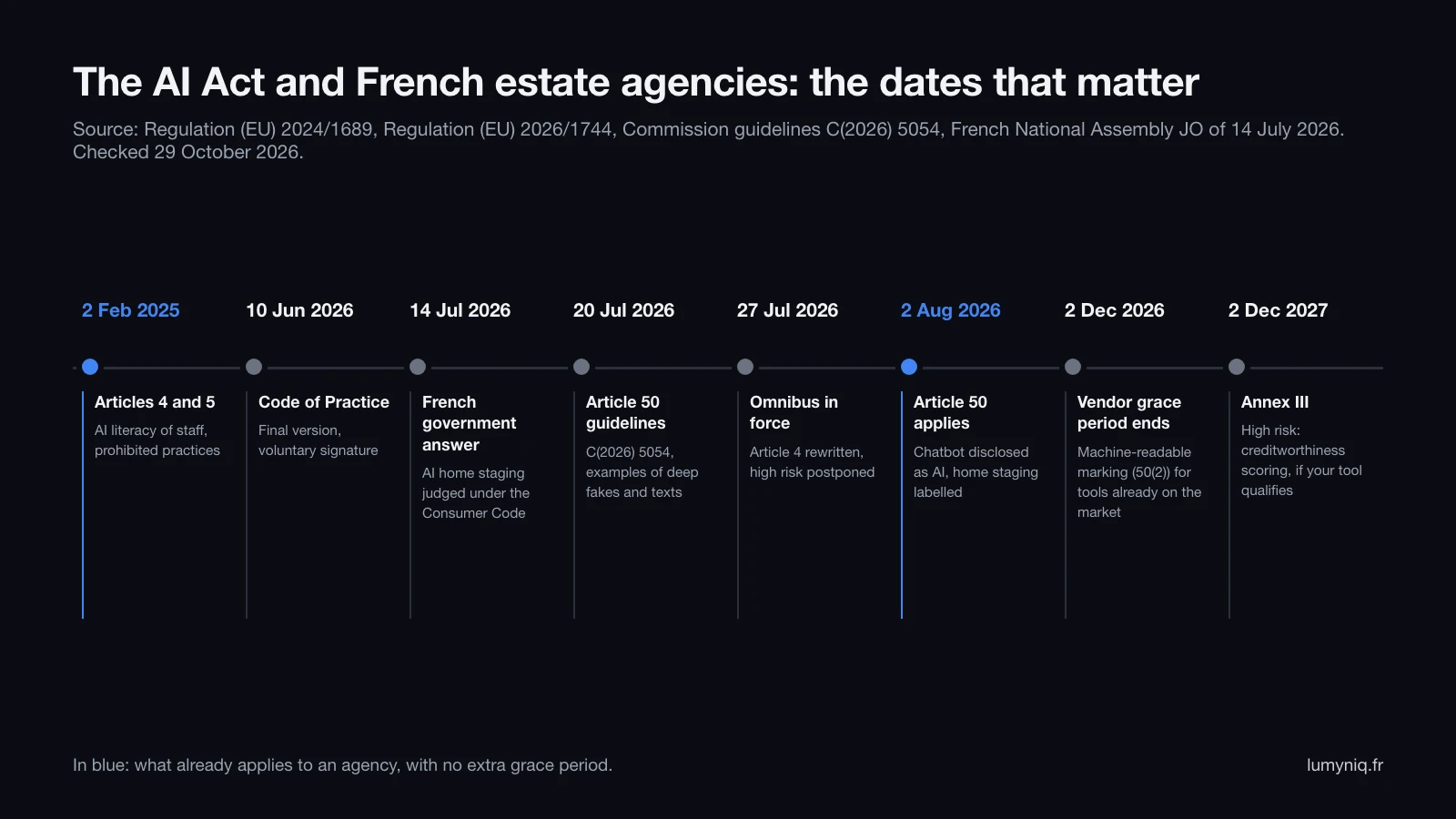
2 December 2026 causes confusion. Regulation (EU) 2026/1744, the Omnibus, in force since 27 July 2026, gives that delay to providers of generative AI systems placed on the market before 2 August 2026, for a single duty: the invisible, machine-readable marking of Article 50(2). Para 153 of the Commission guidelines is explicit: for a system that is both conversational and generative, telling the person they are talking to an AI is due from 2 August 2026.
The visible label on a deep fake comes from a different paragraph, Article 50(4), which falls on the deployer, meaning the agency. No delay applies to it. The full timeline of the regulation, high risk included, is in our guide to the AI Act for businesses.
Article 50(1)
Website and WhatsApp chatbots: who has to disclose the AI?
The guidelines of 20 July 2026 give the example of an organisation that develops a chatbot in-house and puts it into service for its own use under its own name: it is a provider (para 11). A WhatsApp assistant built with an automation tool and a language model, presented as "the Dupont agency assistant", fits that case: the agency then carries the Article 50(1) duty itself.
Three points from the guidelines change day-to-day practice.
- The channel does not matter. Interaction can run through an online interface, the phone or email (para 30). An agent that answers on WhatsApp, calls a buyer back or sends a follow-up email on its own is covered.
- A reviewed draft is not covered. When an agent uses an AI tool to draft a reply and sends it personally, the interaction is not direct (para 30). The text adds that the mere possibility of human review must not be used to sidestep the duty: if nobody reads it, the message comes from the AI.
- Rule-based replies are out of scope. An out-of-office message or a keyword auto-reply in WhatsApp Business is not an AI system (para 30).
That leaves the "obvious" exception. The Commission says to read it narrowly and lists, among the factors that weaken it, a human profile picture and a voice that sounds human (para 45). An assistant called "Julie, your adviser" with a smiling photo is the opposite of obvious. Keep the name if you like and add what it is: "Julie, the agency’s AI assistant". For a voice agent, the guidelines recommend a spoken statement at the start of the call and reminders in long exchanges (para 37).
The GDPR adds its own layer. The CNIL guidance on chatbots, published on 19 February 2021, asks organisations to warn users before the exchange not to share sensitive data, and to purge any they type anyway. It also says a conversation with no human involvement cannot on its own lead to a significant decision such as a credit refusal. A workable greeting fits in two sentences: "Hello, I am the agency’s AI assistant. I can answer about our properties and viewings; for an offer or a personal situation, an adviser will call you back."
Article 50(4), second subparagraph
Does an AI-written listing need a label?
The Commission example (box in para 131) carries a caveat that MySweetImmo’s article of 4 August 2026 does not mention: product descriptions fall outside the scope unless they make claims related, for example, to health, consumer safety or sustainability. A listing that praises a home as "energy-efficient", "low-carbon" or "renovated for the planet" moves closer to that caveat. The risk stays low while a person reviews and owns the text, since human review under editorial responsibility removes the need for a label (para 133). It disappears if the text sticks to what the energy certificate says.
That review has a defined content. The Commission describes it (paras 134 and 135) as a deliberate check of the substance by a competent person who can approve, edit or reject; a spell check does not count. French law already expects the same of an estate agent under the Hoguet law: the information published must be accurate. Check first the surfaces, the equipment such as a cellar or a lift, the orientation and the service charges.
Energy notices are not something to delegate to AI. According to service-public.fr, a French listing online or in an agency window must show the energy and climate classes in colour on the A to G scales, the notice "logement à consommation énergétique excessive" for an F or G property, and the estimated annual energy cost for standard use with the reference year of the prices. The same service-public.fr page, consulted on 29 October 2026, states that the electricity conversion factor fell from 2.3 to 1.9 on 1 January 2026, so an AI that rewrites an old listing can copy a class that has since changed. To make those listings readable by assistants too, see our guide on getting a real estate agency found in ChatGPT.
Article 50(4), first subparagraph
AI home staging: when is a label needed, and where should it go?
Article 3(60) defines a deep fake as AI-generated or manipulated image, audio or video content that resembles existing persons, objects, places, entities or events and would falsely appear to be authentic. The guidelines specify that "objects" include buildings and that the assessment takes account of the context and the audience’s expectations (paras 113 and 114). A buyer looking at a listing expects to see the property as it is.
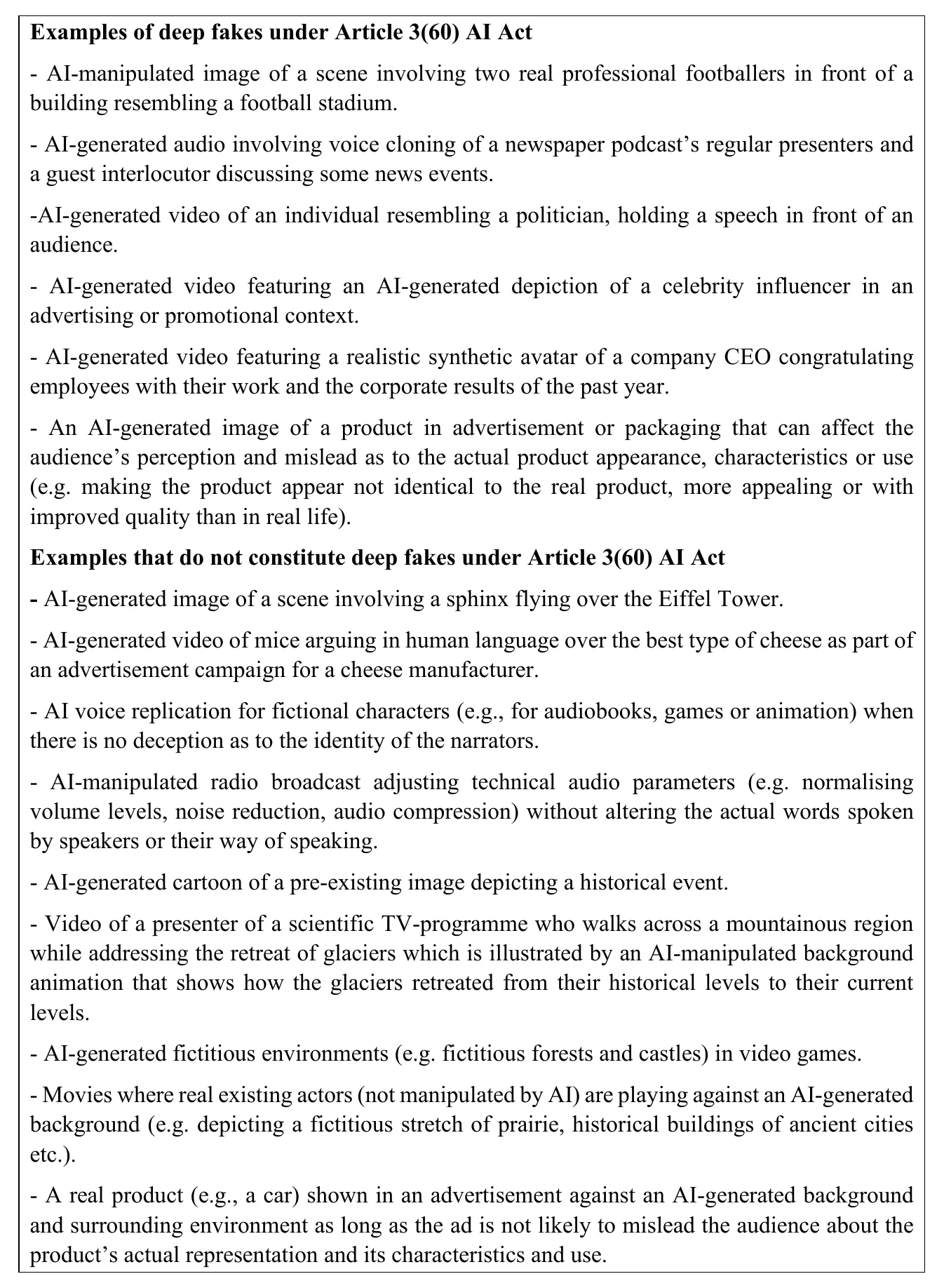
The Commission examples do not mention real estate; here is our reading. In the box that follows para 116, a deep fake includes an AI-generated product image in an advertisement that can mislead about the product’s actual appearance, for example by making it look more appealing or of better quality than in real life. A real product shown against a generated background is not one, as long as the advertisement does not mislead about the product itself. We infer that, in a listing, the product is the home: added furniture changes how the home is perceived and calls for the label.
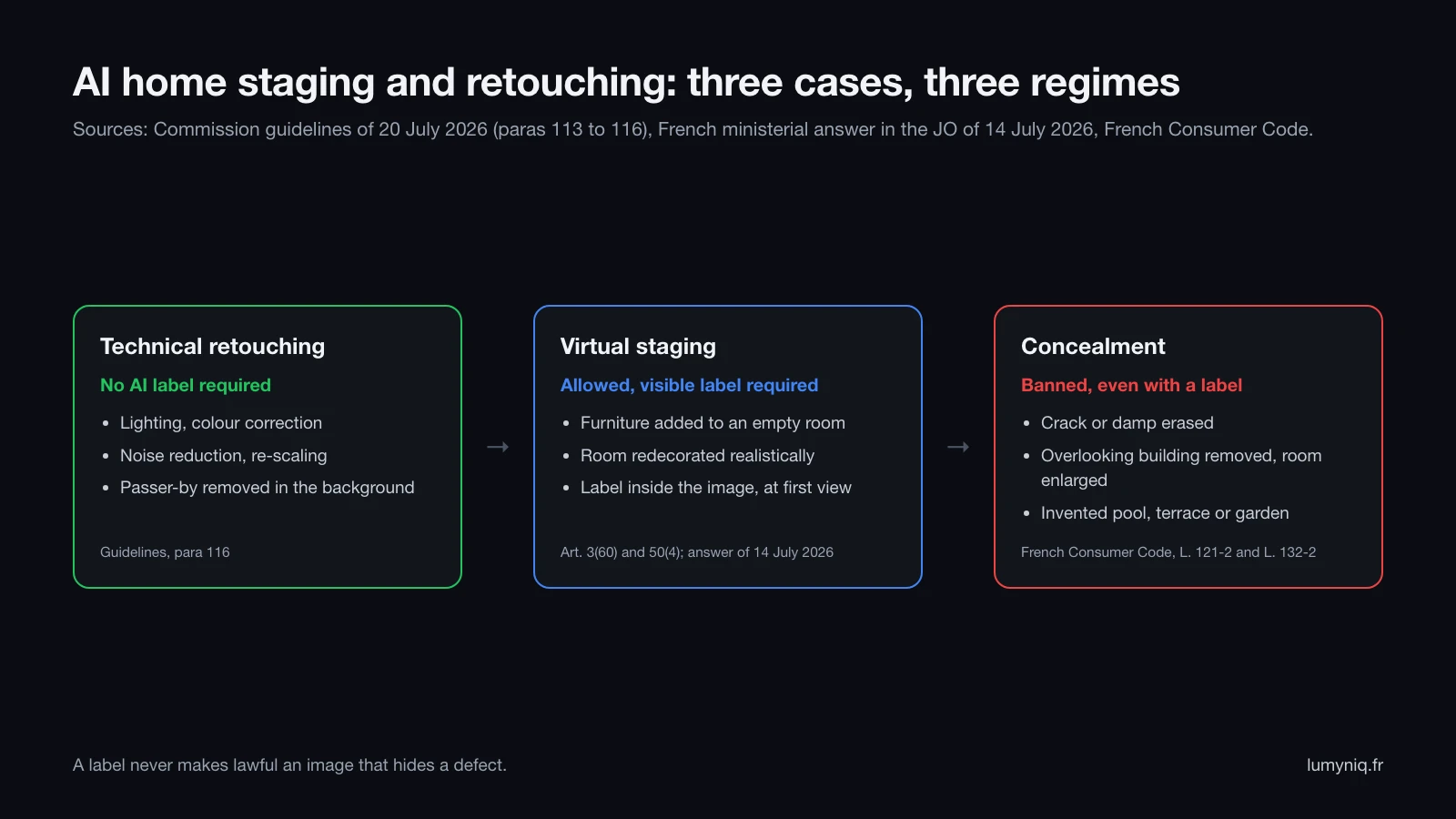
What needs no label. Para 116 lists minor edits that do not change how authentic the content appears: colour correction, lighting, noise reduction, re-scaling, removing a passer-by in the background. The Commission adds that it depends on the context and on the effect on the person’s perception.
Where the label goes. It must be clear, perceivable without any tool, and present at the latest at first exposure (Article 50(5)). The guidelines add two points that matter to agencies. Platforms that only distribute third-party content are not deployers (para 16), so a listing portal has no duty under Article 50(4) to keep your caption. And the deployer should make sure, for instance through contracts or settings, that the label stays visible where the audience sees it (para 12). Article 50(5) sets no location: we recommend writing the line at the bottom of the photo so it stays visible on every portal. The invisible marking inserted by the staging tool is not enough (para 117), and the three EU icons published by the Commission are optional.
Who is the deployer. An agency that generates the image itself is. An agency that orders visuals from a photographer or a home stager, without deciding how AI is used, is not under para 14: the supplier carries the label under the AI Act. French consumer law, however, targets the agency that publishes the listing. Ask in writing for visuals that are already labelled.
Older photos. A deep fake generated before 2 August 2026 does not need retroactive labelling (para 154). A staging photo still online since the summer remains exposed to consumer law, which has no start date: label it too.
What the label does not fix. In its answer published in the Journal officiel on 14 July 2026, the French government accepts showing a property as it would look if furnished, and recalls that the Consumer Code already punishes listings that distort the perception of essential information. The question from MP Édouard Bénard listed what amounts to concealment: erased cracks or damp, a removed overlooking building, an enlarged room, an overgrown garden turned green, an added pool or terrace. The guidelines say the same at EU level: a label does not make misleading advertising lawful (para 129). The Consumer Code provides for up to two years in prison and a 300,000 euro fine (article L. 132-2), and CMS Francis Lefebvre reported on 28 May 2024 higher ceilings of five years and 750,000 euros when the practice is carried out online.
Annex III
Is an AI price estimate high risk?
The eight Annex III areas are biometrics, critical infrastructure, education, employment, access to essential services, law enforcement, migration, and justice and democratic processes. Point 5, essential services, covers four uses: eligibility for public benefits, the creditworthiness and credit score of natural persons, life and health insurance pricing, and emergency call triage. Point 4, employment, does cover an agency that uses AI to screen applications from future sales negotiators: see our guide to AI resume screening compliance in France.
The format matters for transparency. A form where the seller enters the address and floor area and gets a price range resembles the tools the guidelines exclude from Article 50(1) in the box that follows para 31: decision support where the user sees the output without a real exchange. An assistant that asks questions as the conversation goes and comments on the price is a chatbot, and it must say it is an AI.
There is a practical limit too: an estimate model has not visited the property. The valuation the agency hands over commits the agent, and a price gap poorly explained to the seller makes for a fragile listing agreement. In France, if the estimate form is also used to call the seller back, it must collect prior consent to telephone canvassing, required since 11 August 2026 by Article L. 223-1 of the Consumer Code, with the wording set by decree n° 2026-662. We cover that form in our guide to online property valuation and AI agents.
GDPR and Annex III
Lead scoring and tenant files: where is the line?
Lead scoring. Ranking leads by their likelihood to sell or buy grants no right and controls no access to a service. The GDPR requires the profiling to be mentioned in the information given to the person (Articles 13 and 14) and gives them an unconditional right to object when it serves direct marketing (Article 21).
Rental applicant files. Recital 58 of the regulation places housing among the essential services whose access depends on creditworthiness assessment. A tool that scores a file on income and guarantees to decide who gets the lease looks like what point 5(b) targets. The doubt is real and we state it as such; the Commission is preparing guidelines on classification. Three rules already apply without waiting for 2027.
- No rejection by algorithm alone. Article 22 GDPR gives the right not to be subject to a solely automated decision with a significant effect. The CNIL lists the safeguards: human intervention, the chance to give one’s view, the right to contest.
- Limited documents. In France, decree n° 2015-1437 of 5 November 2015 sets the list of documents a landlord or agency may request. The CNIL, on its page of 10 October 2025, cites a fine of up to 3,000 euros for an individual and 15,000 euros for a company for asking for a forbidden document. An AI that "reads the whole file" should only receive those documents.
- No discriminatory criteria. The ministerial answer of 14 July 2026 expressly mentions automated selection of applicants on one of the criteria prohibited by law (sex, age, origin, family situation) and says the DGCCRF would report such practices to the public prosecutor and the Défenseur des droits.
What an AI agent can handle in a tenant file, without deciding in the agency’s place, is covered in our guide to automating property management with AI.
Article 4
Article 4 in an agency: what do you need to be able to show?
The current wording, read on the Commission’s AI Act Service Desk (consolidated version of 27 July 2026), states that the duty does not require guaranteeing any specific level for any individual. For an agency, useful evidence fits in three documents: the list of approved AI tools and what they are for, a written rule on the data you never give them (ID documents, tax notices, payslips), and a record of a session where the team learned to review a generated listing and label a photo. What counts as compliance is detailed in our guide to the AI literacy obligation under Article 4.
The MySweetImmo case
What do MySweetImmo and the ministerial answer of 14 July say?
MySweetImmo, the French real estate trade site, updated its piece on 4 September 2026. It separates provider and deployer, suggests a chatbot greeting and distinguishes projection (furnishing an empty room) from concealment. Estimate tools appear only as a line in an inventory. The article does not mention the sustainability-claims caveat for listings, or the question of labels on portals.
The French government’s answer to written question n° 13930, published in the Journal officiel on 14 July 2026, describes two markings, a visible label and an invisible machine-readable mark, then states: "Pour les systèmes d’IA déjà mis sur le marché au 2 août 2026, ces obligations s’appliqueront à compter du 2 décembre 2026" (for AI systems already on the market on 2 August 2026, these obligations will apply from 2 December 2026). That answer predates the guidelines of 20 July and the Omnibus taking effect on 27 July. Para 153 limits the delay to providers’ machine marking: in our reading, an agency cannot rely on that answer to postpone the label on its own photos.
The guidelines do not bind courts. The Commission’s AI Act Service Desk timeline also describes that delay as limited to certain providers and to Article 50(2).
Euronews wrote on 25 September 2026 that images of AI-furnished flats must carry a transparency pictogram. The Commission presents its three icons as optional. Article 50(5) requires a clear, visible disclosure, in a form the agency chooses.
The limits
What this page does not settle
The status of the guidelines. The Commission communication of 20 July 2026 says they will be formally adopted once all language versions are available, and will only apply from that moment. We did not find that adoption. The text of Article 50 itself has applied since 2 August 2026.
Off-plan sales. A generated render of a building that does not exist yet can plausibly exist in the sense of the guidelines (para 113). The false-appearance test depends on audience expectations (para 114). A line such as "non-contractual render, AI-generated image" reduces the risk.
French law not verified here. Articles L. 121-2 and L. 132-2 of the Consumer Code are cited from the ministerial answer and a law firm, as Légifrance could not be reached by our tools that day. This page reads the texts as they stood on 29 October 2026 and does not constitute legal advice: have your notices checked by your lawyer or trade federation.
Method
In what order to bring an agency into line
- List the tools. Website chatbot, WhatsApp assistant, listing generator, staging tool, online estimate, CRM lead scoring, including agents’ personal accounts.
- Fix the first message of every chatbot. "The agency’s AI assistant", a route to a human, and a test: ask it whether it is human.
- Label photos inside the image. A line at the bottom of every staged visual, and a written clause for visuals supplied by a contractor.
- Review every generated listing. Surfaces, equipment, charges, energy rating. Remove any sustainability claim that does not come from the certificate.
- Update the privacy notice. Lead profiling, retention of conversations, right to object.
- Keep a human on tenant files. No rejection without review, documents limited to the 2015 decree.
For the wider picture of AI projects in the sector, see our guide to AI in real estate. Lumyniq builds custom AI agents for agencies, with the AI disclosure, the handover to a human and logging designed in from the start; it is an agency project, with a set-up time and a budget. Lumyniq is also preparing Agent Studio, which configures an agent from your website pages and tests it against your rules; the waiting list is open.
FAQ