In brief
The short answer
20 to 30%
of comparable 3-room flats sold in 2025 went within 10% of their town median (Annecy 29%, Nantes 30%, Limoges 20%)
Lumyniq calculation on geolocated DVF, October 2026 release, 29 October 2026
× 1.95 to × 2.51
ratio between the 90th and the 10th percentile of price per m² for those sales
Same calculation, 1,537 sales in total
6%
median error of Meilleurs Agents estimates at the end of 2021, according to the publisher
Thomas Lefebvre, Meilleurs Agents, quoted by MySweetImmo on 12 June 2022
8.4%
median error SeLoger reports for apartments in Paris
Baptiste Capron, SeLoger, quoted by MySweetImmo on 11 June 2025
This guide is written for estate agencies working in France. It answers one question: how to capture a seller who goes online to value their home, without giving them a figure the agency cannot defend. The part on telephone canvassing is short, because a whole guide covers it.
The Lumyniq measurement
What is a single figure worth? What 1,537 DVF sales show
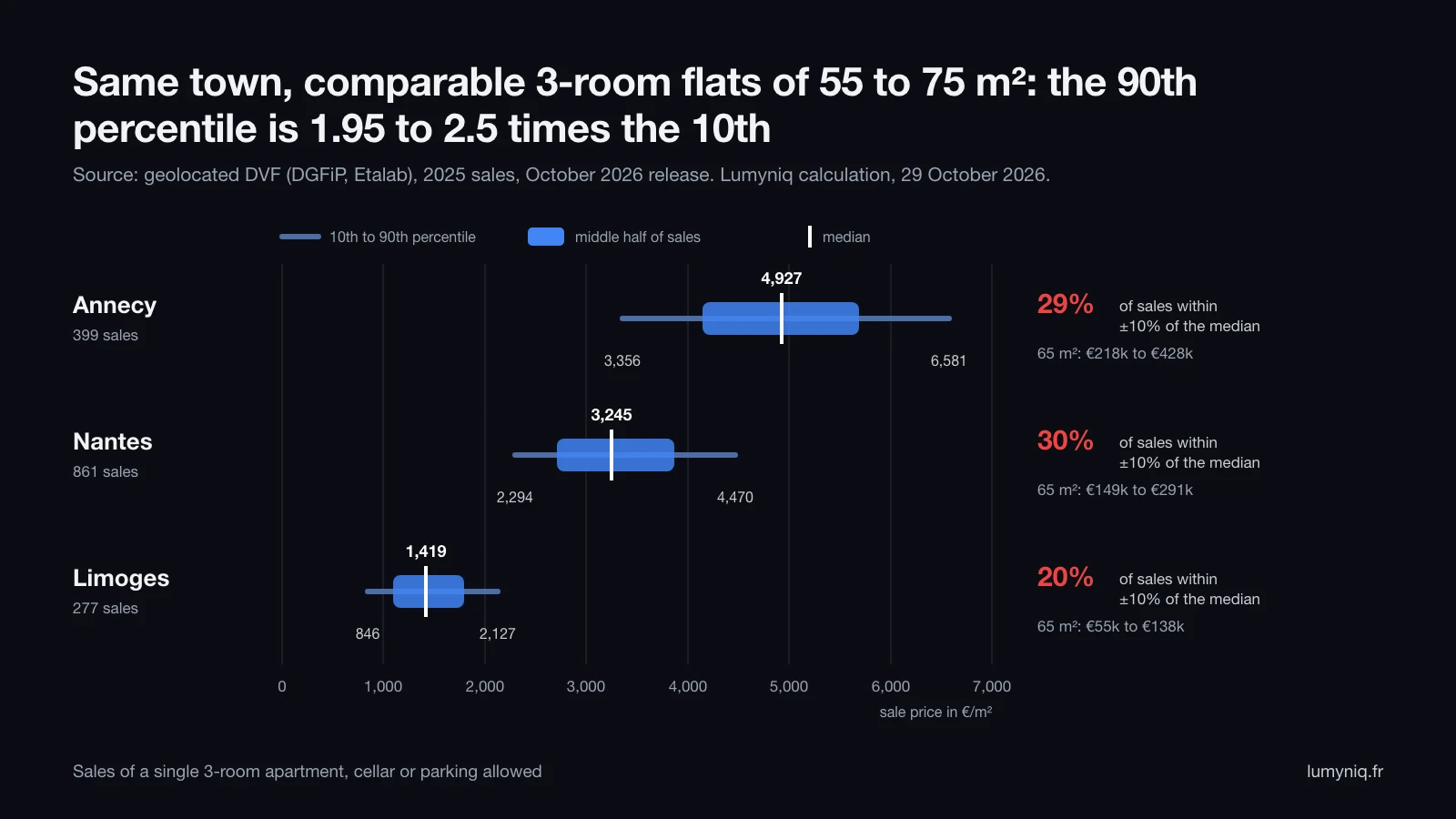
Method. We downloaded the 2025 geolocated DVF file published on data.gouv.fr on 20 October 2026, built from the DGFiP update of 12 October, and kept, for each town, transactions of type “Vente” covering a single apartment with 3 main rooms and 55 to 75 m² of built surface. A cellar or parking space sold in the same deed is allowed, because 78 to 90% of single-apartment sales include one depending on the town: without them, only 12 sales remained in Annecy. Price per m² is the sale value divided by the surface. No sale was removed, and percentiles set extreme values aside on their own.
| Town | Sales | 10th percentile | Median | 90th percentile | Within 10% of median | A 65 m² flat, 10th to 90th percentile |
|---|---|---|---|---|---|---|
| Annecy | 399 | €3,356/m² | €4,927/m² | €6,581/m² | 29% | €218,000 to €428,000 |
| Nantes | 861 | €2,294/m² | €3,245/m² | €4,470/m² | 30% | €149,000 to €291,000 |
| Limoges | 277 | €846/m² | €1,419/m² | €2,127/m² | 20% | €55,000 to €138,000 |
Closer in, the spread stays. In the Nantes cadastral section with the most sales of this kind (20 sales), prices run from €2,786 to €4,650 per m². In the busiest Annecy section (15 sales), from €3,194 to €6,102. Going down to postcode helps a little: in Annecy the median moves from €4,486 per m² in 74960 to €5,717 in 74940. Since 2017 the merged town of Annecy has combined six former communes, so its median blends different markets.
Why the spread is so wide. DVF records neither condition, floor, energy rating nor view. Part of the spread is real differences between homes. Part comes from the data: sales between relatives, partial sales, parking counted in the price. Meilleurs Agents makes the same point in its method note: even two identical flats in the same building do not sell at the same price.
What the reported errors mean. A 6% median error means half of the estimates miss the sale price by more than 6%. On a 65 m² Annecy 3-room flat at the median price, about €320,000, 6% is €19,000. At 8.4%, SeLoger’s figure for Paris, the gap is €27,000. Meilleurs Agents describes Paris, with about 30,000 apartment sales a year, as the best case in France for data density. We infer, without a published figure to check it, that estimator error is unlikely to be lower elsewhere.
The sources
Where do online estimators get their prices, and what error do they report?
| Source | What it holds | Error reported by the publisher | Limit to know |
|---|---|---|---|
| DVF (DGFiP, data.gouv.fr) | Sales of the last five years, with price, date, surface and rooms. Excludes Alsace, Moselle and Mayotte | Not applicable: these are actual sales | No condition, floor or energy rating. Updated in April and October. Unusual sales not filtered out |
| French notaries (Perval, BIEN) | Perval covers a little over 80% of transactions, outside Île-de-France; complete reporting since summer 2021 | None for a given home. The Notaires-Insee indices track price change at constant quality | Built to follow the market as a whole |
| Meilleurs Agents | Sale agreements from partner agencies (25% of 2022 transactions), Île-de-France notaries, DVF elsewhere | 6% median error at end 2021 (publisher’s statement, 2022). Confidence index from 1 to 5 based on data volume | The figure dates from 2021. The index flags areas where data is thin |
| SeLoger | 15 years of consolidated data, expertise "historically carried by Meilleurs Agents", over 600,000 estimates a month | 8.4% median error for apartments in Paris (publisher’s statement, 2025) | No figure published outside Paris that we could find |
| "Rechercher des transactions immobilières" (impots.gouv.fr) | DGFiP sales, open to prospective sellers and buyers since 2 May 2017 | Not applicable: a list of sales | Access through the personal tax account, reason must be stated |
Two points in this table change how a figure should be presented. First, Meilleurs Agents shows a confidence index because it knows its accuracy depends on how many sales exist nearby. An agency agent showing a range should do the same: say how many sales it rests on and when they took place. Second, according to Meilleurs Agents, DVF lags the final deed by 6 to 18 months, up to two years on the data. The 2025 sales file measured above is the one published in October 2026.
This is where an agency holds something the portals lack: its own recent sales, with the condition and floor of each home. An agency that keeps them in its own system can feed its agent with comparables nobody else has. We explain how in our guide on the data a real estate agency must own.
The text
Can an agency give a price online? What the French code of ethics says
The code of ethics applies to every holder of the professional card created by the law of 2 January 1970. Three articles matter for valuation, and we read them in the text on Légifrance on 29 October 2026.
- Article 6, transparency, 4°. When asked for a price opinion, the professional must inform the client that this opinion is not an appraisal (« Lorsqu’elles sont sollicitées pour établir un avis de valeur, à informer leur client que cet avis ne constitue pas une expertise »).
- Article 9, conflict of interest, 3°. They must not value a property in which they hold or plan to acquire an interest, unless they state it in the price opinion (« A ne pas accepter d’évaluer un bien dans lequel elles possèdent ou envisagent d’acquérir des intérêts, sauf à en faire état dans leur avis de valeur »).
- Article 4, competence. They turn down assignments they lack the skills for, or bring in a qualified person and tell the client.
On liability, Weblex summarised on 4 May 2021 a ruling of the Rouen Court of Appeal of 25 March 2021 (no. 19/01978): a valuation does not have the status of an appraisal and still makes its author liable when the author is a property professional. The seller must still prove a fault, a loss and the link between them. We found no ruling from the Cour de cassation on an automated online estimate.
For an AI agent this translates into three rules. It quotes a range of public sales with its source, and labels it as such. It tells the seller that this range is neither a price opinion nor an appraisal. And it leaves the human agent to write the price opinion after the visit, with the article 6 statement. We are not lawyers: have the agent’s messages reviewed by your counsel or your trade federation.
The context
Why the valuation form matters more since 11 August 2026
Law 2025-594 of 30 June 2025 rewrote article L. 223-1 of the Consumer Code, and decree 2026-662 of 23 July 2026 sets the five items of valid consent, its maximum duration of one year and the three years of proof to keep. The DGCCRF, the consumer protection authority, restated this in its practical sheet written on 27 July 2026. The details, including the five-day callback exception that does not cover real estate, are in our guide France’s cold-calling ban: how estate agencies still find sellers.
The diagram
The qualification flow of an AI agent, question by question
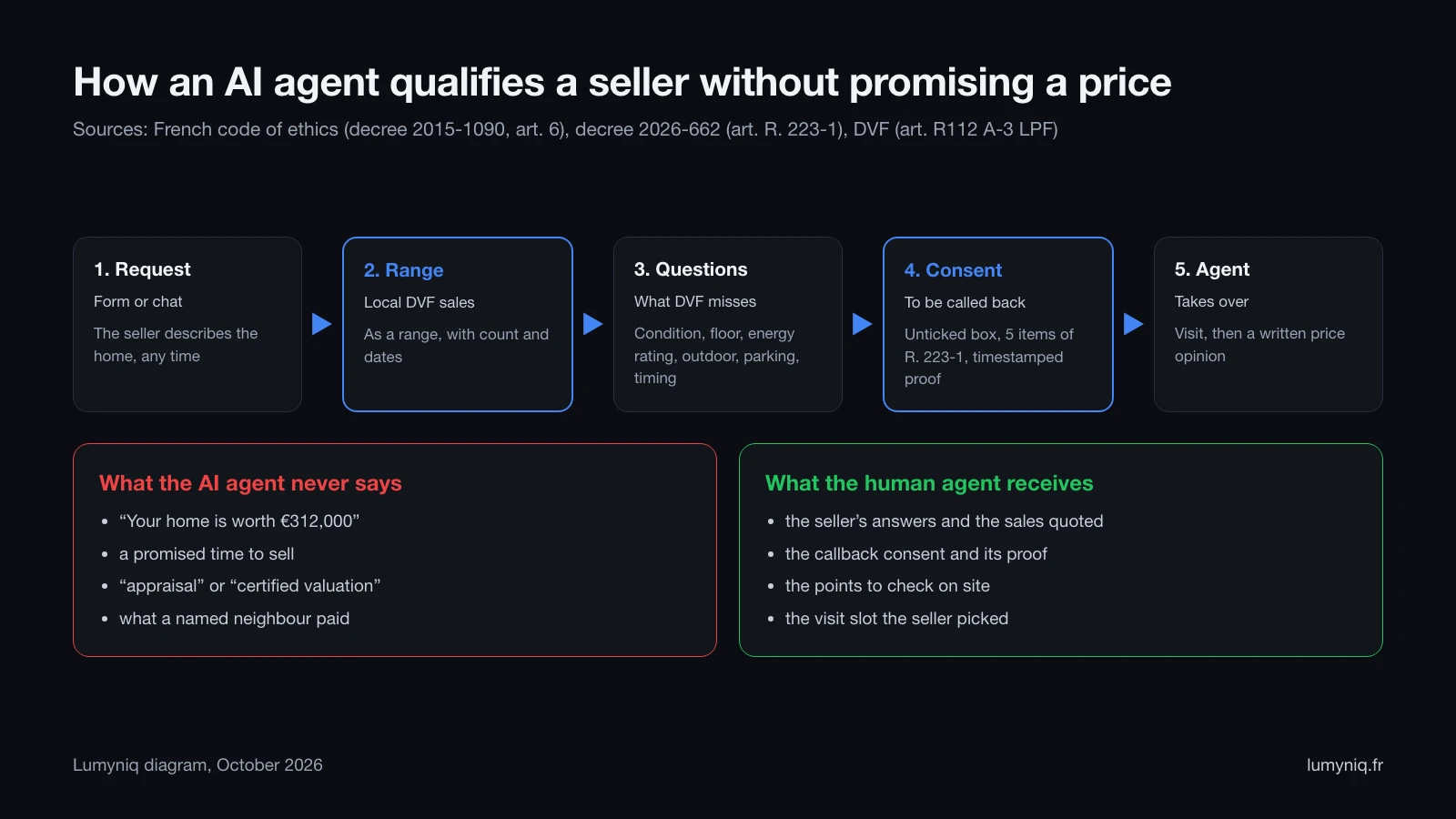
The questions, in order
| The agent asks | Why it matters |
|---|---|
| What is the address, or at least the street? | It selects the comparable sales. The town alone mixes markets, as in Annecy |
| Surface, number of rooms, floor, lift? | DVF holds surface and rooms; the floor is missing. A 4th floor walk-up does not compare with a 1st floor |
| Overall condition, recent works, energy rating? | DVF ignores them, and they decide whether the home sits at the top or bottom of the range |
| Balcony, terrace, cellar, parking? | They are often sold in the same deed and inflate the price per m² of comparables |
| When do you want to sell, and why? | A job move, a buy-and-sell or an inheritance need different handling |
| Is the home already listed or valued by another agency? | The human agent arrives prepared, without discovering an existing mandate during the visit |
| Would you like a call back, and when? | This is where consent is collected, with an unticked box and the items set by the decree |
A sample reply
Asked "what is my 65 m² 3-room flat in Nantes worth?", a well-configured agent would answer roughly this: "Across Nantes, 861 3-room flats of 55 to 75 m² sold in 2025. The middle half sold between €2,712 and €3,866 per m². This comes from public DVF sales and is neither a price opinion nor an appraisal: the condition, floor and energy rating of your home will place it inside this range or outside it. To narrow it down, which street is your home in? I will then ask three questions to prepare our agent’s visit."
When the agent hands over at once
- The seller insists on a single figure, or disputes the range.
- They mention an inheritance, a divorce, joint ownership or a dispute.
- They send photos, a diagnostic report or a floor plan: the human agent should see them directly.
- They ask for an appointment, or have agreed to be called back.
What the human agent receives matters as much as the conversation: the seller’s answers, the sales quoted, the proof of consent and the slot chosen. Without that brief, the seller repeats everything on the phone and the time saved disappears. The brief therefore has to land in the human agent’s own tool, which means you need to connect the agent to your real estate CRM.
Public data
What an agent can show from DVF data, and what it should avoid
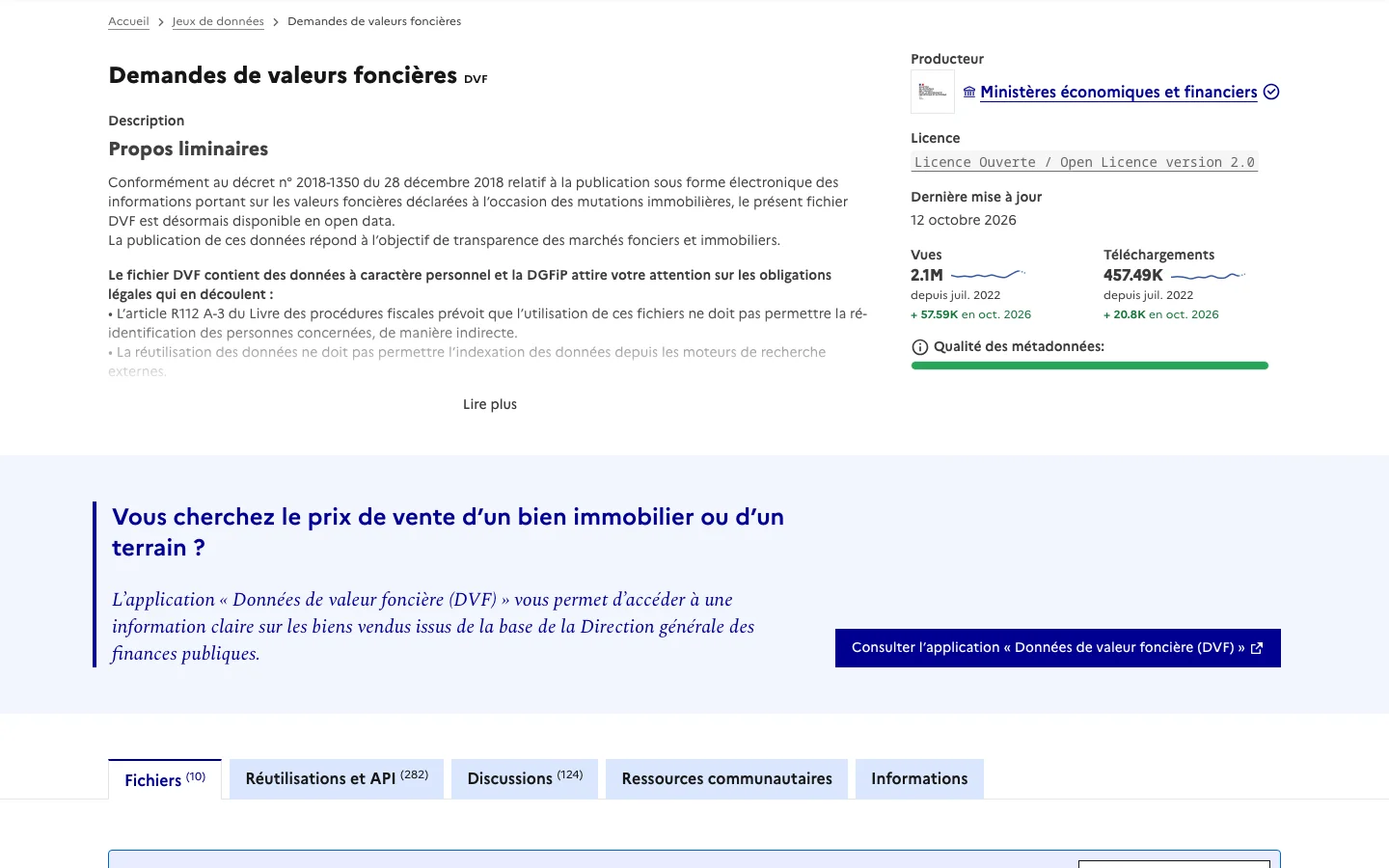
In a private conversation, the agent can quote sales close to the home, since the seller could find them on the public explorer. A page of the site open to search engines raises a different problem: a "sale prices street by street" page generated from DVF conflicts with the second condition. That is our reading of the DGFiP conditions; have it checked if your site publishes sales.
The other rule is about form: a range comes with its date and volume, for example "861 sales in 2025".
GDPR
The form and the conversation: what GDPR and the CNIL require
- Information. Who processes the data, for what, for how long, and how to exercise rights, under the form and at the start of the conversation. Article 13 of the GDPR sets the list.
- Minimisation. The address, surface and project are enough for a first range. Date of birth or family situation have no place in a valuation form.
- Retention. Three years for a prospect under the CNIL’s reference framework for commercial management, from collection or from the last contact the person initiated, such as a click in an email. For a chatbot history, the CNIL wrote on 19 February 2021 that the period depends on the purpose.
- Sensitive data. A seller may write unprompted that they are selling because of an illness or a death. The CNIL recommends a warning asking people not to share sensitive data, and purging what still arrives.
- No decision by the machine alone. According to the same CNIL sheet, a conversation without human involvement cannot by itself lead to a significant decision about the person. An agent that dropped a seller judged "not worth it" without human review would fall outside that frame.
- The callback. Consent to a phone call is a separate box, never pre-ticked, with the items set by decree 2026-662, and its proof is kept for three years.
Since 2 August 2026, article 50(1) of Regulation (EU) 2024/1689 requires that the person be informed they are interacting with an AI, unless it is obvious. The details for an agency are in our guide to the EU AI Act for estate agencies.
The tools
Valuation software, an AI agent, or both?
An agent is only as good as what it knows about the agency. It should answer from the agency’s own pages: area covered, fees, recent sales the agency is willing to show, how it works. If those pages do not exist, the agent improvises or stays silent. The same pages also serve assistants like ChatGPT, which recommend agencies they have read about.
At Lumyniq, one route exists today; the second, Agent Studio, is in preparation: you paste your website address, and it sets up an agent that answers from those pages on WhatsApp, Telegram, Messenger, email and the site, and that is tested against your rules. It has not launched yet; the Agent Studio waitlist is open. For a flow connected to your transaction software, with your own comparables, you need a custom AI agent. That is a project run with an agency, with a set-up period and a dedicated budget. The wider picture of use cases is on our page on AI in real estate.
For the seller
Valuing a home yourself: the method the agent can explain
- Open the DVF explorer on data.gouv.fr, or the "Rechercher des transactions immobilières" service in your impots.gouv.fr account.
- Keep sales of the same type and similar surface, in the same street or district, over two years.
- Note the range between the first and third quarter of prices, and the number of sales.
- Place yourself higher or lower according to condition, floor, outdoor space and energy rating.
- Compare with an online estimator, reading its confidence index when it shows one.
- Ask one or two local agencies for a written price opinion after a visit.
An agency agent that explains this method to a seller loses nothing. It shows the agency knows its sources, and the seller arrives at the visit with precise questions.
Limits
What the AI agent does not fix
Accuracy. The agent does not see the home. Its range keeps the full width measured above until a professional visits.
Traffic. An agent on a site nobody visits qualifies nobody. Inbound demand is built with useful pages, and that work takes months.
Follow-up. If the brief sent to the human agent goes unanswered for two days, the seller may have contacted other agencies in the meantime.
The measurement. Our calculation covers three towns, one year and one property type. It shows the order of magnitude of the spread and does not claim to describe all of France. The filters are set out in the method above, for anyone who wants to repeat it for their own town.
The law. This page reads the texts as of 29 October 2026 and is not legal advice.
FAQ