In short
The short answer
3 of 7
Tasks an AI agent may carry out alone, under conditions; two more under human control
Lumyniq reading of law n° 70-9 and decree n° 72-678, 29 October 2026
14 days
Withdrawal period for a mandate signed remotely or off-premises by a private seller
French Consumer Code, article L. 221-18, on our reading
3 months
After which an exclusive mandate can be terminated with fifteen days’ notice
Decree n° 72-678, article 78
10 years
Retention period for mandates and the mandate register
Decree n° 72-678, article 72
The Hoguet law (loi n° 70-9 of 2 January 1970) is the French statute that licenses estate agents, property managers and condominium managers. This page is written for readers outside France: agency groups opening French offices, investors working with French agencies, and software vendors selling AI agents into the French market. It is not legal advice. It reads the texts; it does not replace a French lawyer or a professional association such as the FNAIM or the SNPI.
It does not cover phone prospecting of sellers, explained in our guide to France’s cold-calling ban for estate agencies, nor which tasks are worth automating, covered in the five AI automations that work in estate agencies.
The core table
Task by task: what each article says
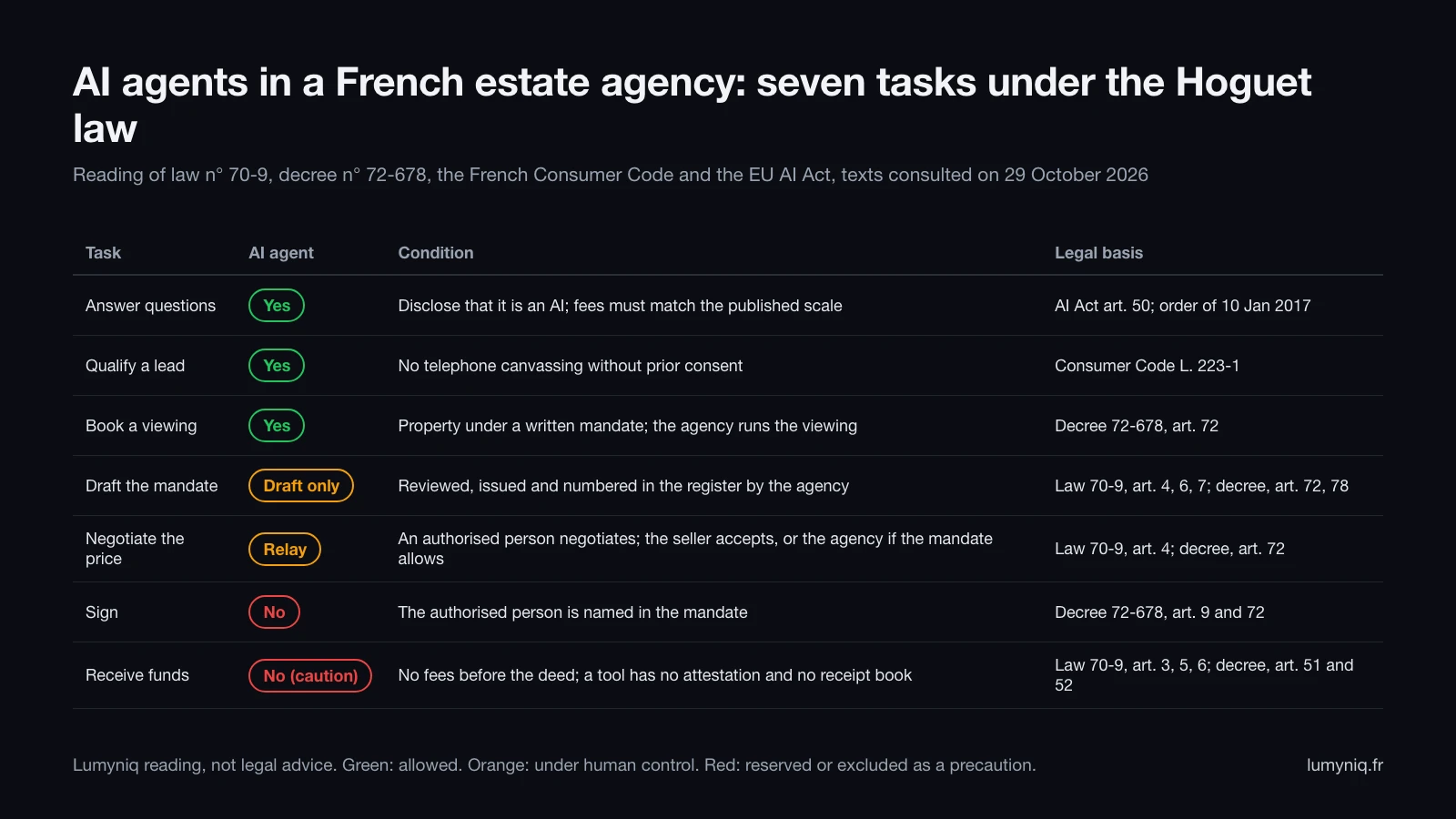
| Task | AI agent | Condition | Legal basis, quoted |
|---|---|---|---|
| Answer questions | Yes | Disclose that it is an AI from the first exchange; state fees from the published scale | AI Act, art. 50(1): people are “informed that they are interacting with an AI system”. Order of 10 January 2017, art. 2: display “the maximum prices charged for the services”. |
| Qualify a lead | Yes | Inbound written exchange is open; telephone canvassing of a private individual needs prior consent | Consumer Code, L. 223-1: “It is prohibited to canvass by telephone […] a consumer who has not previously expressed consent”. The Hoguet law does not address this task. |
| Book a viewing | Yes | Only for a property under a written mandate entered in the register; the agency runs the viewing | Decree, art. 72: the card holder “may not negotiate or make commitments […] without holding a written mandate issued beforehand”. |
| Draft the mandate | Draft only | Agency template, reviewed by a person, numbered in the register before sending | Law, art. 6 I: agreements “must be drawn up in writing”. Law, art. 4, 2°: non-employee authorised persons draft no private deeds “except mandates”. Decree, art. 72: “All mandates are entered in chronological order in a register of mandates”. |
| Negotiate the price | Relay | The AI relays offers and counter-offers; an authorised person negotiates, and the price is accepted by the seller, or by the agency if the mandate allows it to commit | Law, art. 4: the “person authorised by a holder of the professional card to negotiate, act as intermediary or make commitments”. Decree, art. 72: to commit, “the mandate expressly says so”. |
| Sign | No | The seller signs; for the agency, the card holder or the named authorised person | Decree, art. 9: “The name and capacity of the holder of the attestation must be stated in the agreements”. |
| Receive funds | No, as a precaution | Lumyniq rule: the tool handles no money. The law forbids any fee before the deed; other funds go through a guaranteed card holder, with register and receipt | Law, art. 6: nothing is due “before one of the operations referred to in that article has actually been concluded and recorded”. Decree, art. 52: “All payments or deliveries must give rise to the issue of a receipt”. |
The “Draft only” and “Relay” rows need the most care. They describe tasks where the AI agent does part of the work, formatting a mandate or relaying an offer, and where an authorised person must step in before the agency is committed. That is where a badly configured agent makes its mistakes: a fee field filled in by inference, a counter-offer sent without approval.
The people
Who may act: the carte T, authorised persons, commercial agents
Article 1 of law n° 70-9 sets the scope. It covers persons “who, on a habitual basis, engage in or assist, even on an ancillary basis, in operations concerning the property of others”, including, at 1°, “the purchase, sale, search, exchange, letting or subletting” of buildings. An agency answering a buyer about a property it is marketing is assisting in a sale: what its AI agent does falls within that scope.
Article 3, in the version in force since 17 July 2025, reserves these activities to “holders of a professional card”, issued by the president of the local chamber of commerce and industry. There are four conditions: professional competence, a financial guarantee (except for those who declare they will hold no funds), professional liability insurance, and no disqualification. The nickname “carte T” comes from the mention on the card, quoted word for word in article 72 of decree n° 72-678.
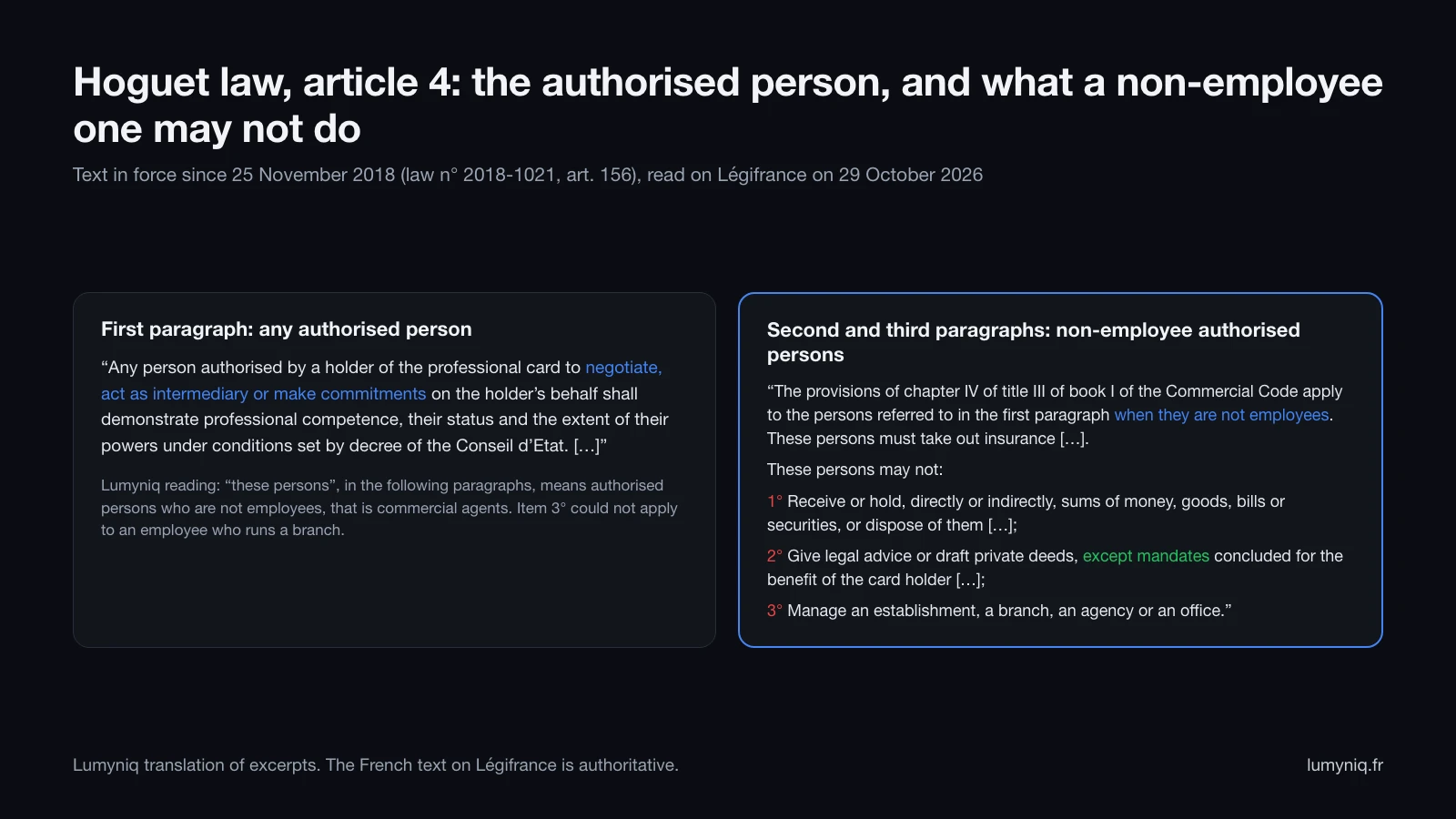
“Any person authorised by a holder of the professional card to negotiate, act as intermediary or make commitments on the holder’s behalf shall demonstrate professional competence, their status and the extent of their powers under conditions set by decree of the Conseil d’Etat.”
The second paragraph deals with authorised persons who are not employees: the commercial agent status of the French Commercial Code applies to them, and “these persons must take out insurance”. The third paragraph follows: “These persons may not”, then lists three bans: receiving or holding funds, giving legal advice or drafting private deeds other than mandates, and managing an establishment. On our reading, “these persons” means non-employee authorised persons, that is commercial agents: the sentence follows the one that names them, and a ban on managing a branch could not apply to an authorised employee who manages one.
The decree sets out the proof of powers in article 9, re-read on 1 November 2026 in the version in force since 1 July 2015: “Any natural person authorised by a holder of the professional card […] shall prove their status and the extent of their powers by producing an attestation”, endorsed by the president of the CCI and then issued by the card holder. The text says “natural person”: on our reading, software cannot receive an attestation.
The risk is criminal. Article 14 of the law punishes “by six months’ imprisonment and a fine of 7,500 euros” operating without a card, and its last paragraph applies the same penalties to anyone who “negotiates, acts as intermediary or makes commitments on behalf of the holder of a professional card, without having been authorised”. These penalties target persons. On our reading, if an AI agent negotiates for the agency, the organisation set up by the card holder is what is in question.
The grey zone
Where the law is silent: software is not a person
The French government was asked about AI in real estate in written question n° 13930 from MP Édouard Bénard, published in the Journal officiel on 31 March 2026, about photos retouched with AI. The reply, published on 14 July 2026 (page 6658), creates no new French rule: it points to the obligations of the AI Act, set out in our guide to the EU AI Act for estate agencies, and considers that the Consumer Code “already makes it possible to sanction professionals” who present a property misleadingly. It also notes that the DGCCRF, the consumer protection authority, regularly investigates real estate professionals.
Three practical consequences follow from this silence, on our reading.
- An AI agent cannot be authorised. The article 9 attestation is issued to a natural person. What article 4 reserves to the authorised person, negotiating, acting as intermediary, making commitments, must go through a human who holds that status.
- What the agent says, the agency says. A wrong answer on floor area, service charges or fees is information given by the agency. The professional liability insurance under article 3, 3° is the one that will respond.
- A price concession decided by the machine has no legal basis. No text provides for software negotiating on behalf of the card holder. The cautious reading is to forbid it.
We cite no case law: we have identified no published decision on an AI agent in an estate agency, and this page does not invent one.
Open to the AI agent
Answering and qualifying: what the agent does alone
Article 50(1) of Regulation (EU) 2024/1689, applicable since 2 August 2026, requires systems intended to interact with people to be designed so that they are “informed that they are interacting with an AI system, unless this is obvious from the point of view of a natural person who is reasonably well-informed, observant and circumspect”. Paragraph 5 sets the timing: “at the latest at the time of the first interaction or exposure”.
The obligation rests on the provider. Article 3 counts as a provider a body that “has an AI system […] developed” and puts it into service “under its own name or trademark”. On our reading, an agency that has its agent built therefore carries the obligation. An agency that buys an off-the-shelf tool is a deployer, and the vendor must have built the disclosure in; our guide to the EU AI Act for estate agencies covers both cases, and our page on the AI agent transparency obligation gives the timeline.
On fees, the order of 10 January 2017 applies to “any professional who, in any capacity, acts to put buyers or tenants in contact with sellers or landlords”. Article 2 requires the agency to display “the maximum prices charged for the services” and to say who pays them. An AI agent quoting a rate must read the scale the agency publishes. If it computes an amount from a percentage it has misread, the agency has displayed a price it does not charge.
Valuation is a related case. As our guide to online property valuation with an AI agent explains, the Hoguet law does not reserve valuation to estate agents, and the code of ethics annexed to decree n° 2015-1090 requires agents to state that a price opinion is not an expert appraisal. The AI agent gives a sourced range; the argued price comes from the negotiator.
Legal advice is a separate case. Article 4, 2° forbids non-employee authorised persons, the commercial agents, from “giving legal advice”. As a precaution, an AI agent answering for the agency follows the same rule and refers questions on inheritance, tax or matrimonial property to the notary or a lawyer. Qualification itself, budget, timing, financing, property to sell, raises no difficulty under the Hoguet law. The Consumer Code steps in as soon as the agent picks up the phone: since 11 August 2026, article L. 223-1 prohibits canvassing by telephone a consumer who has not given prior consent.
Open to the AI agent
Booking a viewing: only for a property under mandate
“The holder of the professional card bearing the mention ‘Transactions sur immeubles et fonds de commerce’ may not negotiate or make commitments in connection with operations specified in article 1 (1° to 5°) of the aforementioned law of 2 January 1970 without holding a written mandate issued beforehand for that purpose by one of the parties.”
In practice, the AI agent should read the mandate status in the transaction software before offering a slot. A property that has been spotted but not yet entrusted to the agency is not shown. The texts reviewed do not say who must conduct the viewing. On our reading, a viewing where the price is discussed amounts to acting as intermediary and therefore belongs to an authorised person.
Under human control
Drafting the sale mandate: what the text requires
Article 6 I of the law requires that agreements “must be drawn up in writing” and specify: the conditions under which the agency may receive or hand over funds, how it accounts for them, how the fee is determined and which party bears it, and the means used to advertise listings. For an exclusive mandate, the agreement “specifies the actions the agent undertakes to carry out” and how it reports on them.
Article 7 adds a ground for nullity: “Promises and agreements of any kind relating to the operations referred to in article 1 that do not limit their effects in time are void.” When the seller is a private individual and the mandate is exclusive, the termination rule of article 78 of the decree must appear in very prominent characters.
“After a period of three months from its signature, the mandate containing such a clause may be terminated at any time by either party, provided the party wishing to end it notifies the other at least fifteen days in advance by registered letter with acknowledgement of receipt.”
The register is the piece the AI agent does not manage. Article 72 of the decree requires that “All mandates are entered in chronological order in a register of mandates”, that the entry number be copied onto the seller’s copy, that the register be “numbered in advance without gaps and bound” or kept electronically, and that mandates and register be kept for ten years. A draft prepared by the AI has no number: it receives one when the agency issues it.
Article 4, 2° concerns non-employee authorised persons, the commercial agents. It forbids them from drafting private deeds, “except mandates concluded for the benefit of the card holder”. The mandate is therefore the only deed of this kind a commercial agent may draft. For an AI agent, we apply the same limit as a precaution: it fills in the template from the software, seller identity, property description, price, duration, fees from the scale, and flags a missing mention. It does not choose a fee rate, set a duration or add a clause.
Consumer Code
Mandates signed remotely: withdrawal and information
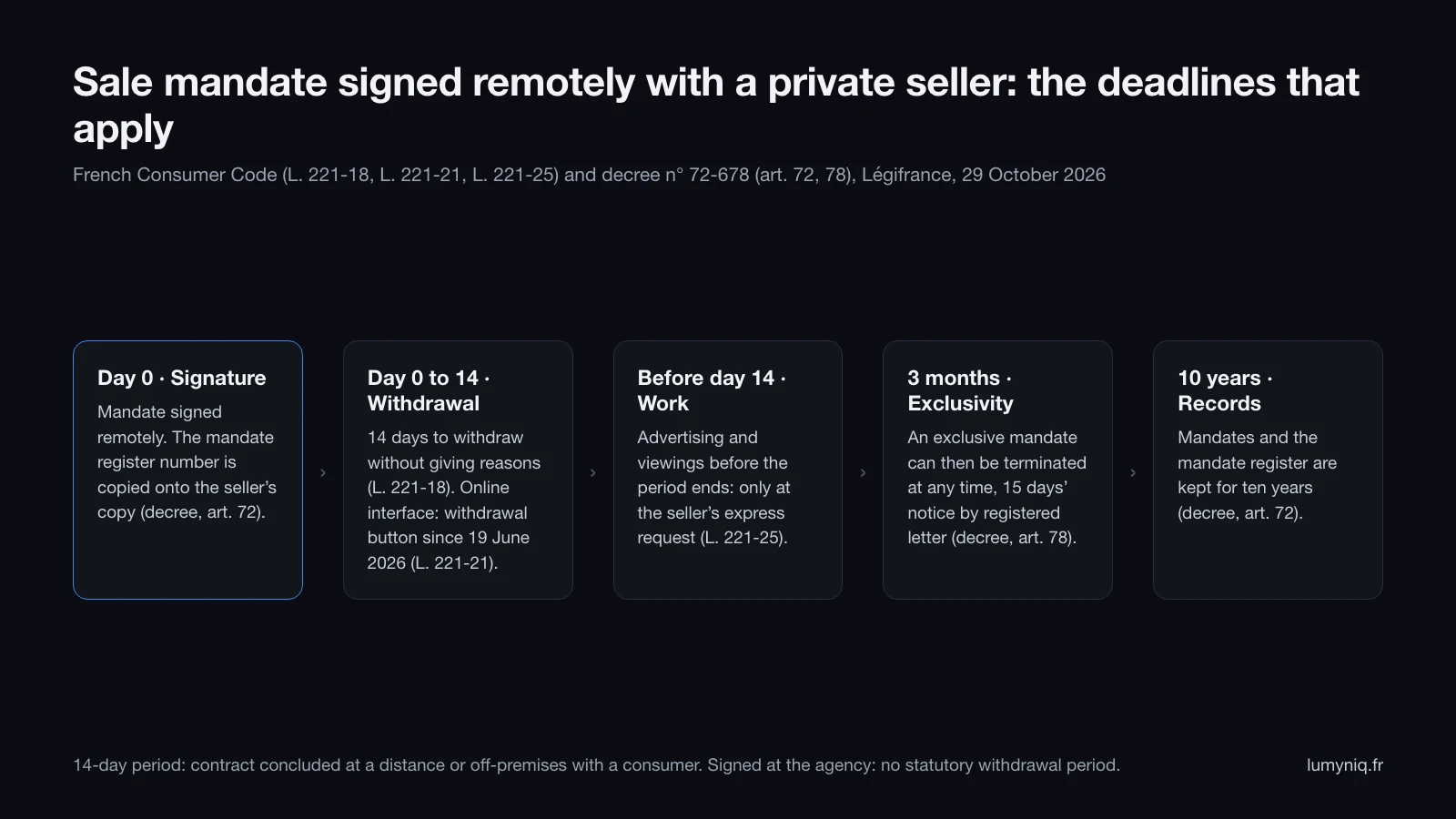
“The consumer has a period of fourteen days to exercise the right of withdrawal from a contract concluded at a distance, following telephone canvassing or off-premises, without having to give reasons […].”
On our reading, a sale mandate given by a private individual to an agency is a service contract between a professional and a consumer. Signed online, it falls within this regime. Signed at the seller’s home, it is concluded off-premises and opens the same period. Signed at the agency’s premises, it does not open this period.
Before signature, article L. 221-5, in the version in force since 19 June 2026, requires the agency to give, “where the right of withdrawal exists, the conditions, time limit and procedures for exercising that right as well as the model withdrawal form”. If that information is missing, article L. 221-20 extends the withdrawal period “by twelve months from the expiry of the initial withdrawal period”. If the agency wants to publish the listing or organise viewings before the fourteen days are over, article L. 221-25 requires it to obtain the seller’s “express request”.
The newest point dates from 19 June 2026. Article 3 of ordinance n° 2026-2 of 5 January 2026 amended article L. 221-21, which now provides that “for contracts concluded at a distance by means of an online interface, the professional makes available to the consumer, free of charge, a function enabling them to exercise their right of withdrawal free of charge”. A signature flow launched by an AI agent on the agency’s website is an online interface. Article 26 of the ordinance states that “contracts in progress on 19 June 2026” remain governed by the former wording.
For the AI agent, that gives three rules: attach the information and the form to every signature request, record the express request before any publication, and keep the withdrawal link visible in the flow.
Reserved to a person
Negotiating and signing: where an authorised person is required
The decree frames the agency’s power to commit the seller. Under article 72, where the mandate “includes authorisation to make a commitment for a specific operation, the mandate expressly says so”. Without that mention, the agency does not bind the seller. With it, the commitment is made by the card holder or by the authorised person whose “name and capacity” article 9 requires to appear in the agreement “when they take part in concluding it”.
Electronic signature does not change the roles. The AI agent may trigger the sending of an approved document to the signature platform. The signatories remain the seller or buyer and, for the agency, an identified person. One simple setting holds the line: any message from the agent containing an amount not in the listing goes to human approval before it is sent.
Commercial negotiation in the everyday sense raises the same question. An AI agent replying “the seller would accept 5% less” is negotiating. No text addresses software that negotiates, article 4 gives that verb to an authorised person, and article 14 punishes whoever negotiates for the card holder without authorisation. On our reading, the cautious answer is not to allow it.
Excluded as a precaution
Receiving funds: the clearest line
“No property, bill, security or sum of money representing fees, search, canvassing, advertising or any intermediary costs is due to the persons referred to in article 1, nor may be demanded or accepted by them, before one of the operations referred to in that article has actually been concluded and recorded in a single written deed containing the commitment of the parties.”
For funds that are not fees, a card holder may receive them if covered by the financial guarantee under article 3, 2°. Article 5 refers to the decree for “the formalities of keeping registers and issuing receipts”. The decree requires all payments to be “immediately entered in a register-directory” (article 51) and states that “All payments or deliveries must give rise to the issue of a receipt” (article 52). Article 16 of the law punishes “by two years’ imprisonment and a fine of 30,000 euros” receiving or holding funds outside these conditions.
The decree also says who may issue those receipts. Article 52 lets the card holder entrust receipt books to persons holding the acknowledgement or attestation provided for in articles 8 and 9. Authorised commercial agents are excluded by article 4, 1° of the law, which forbids them to “receive or hold, directly or indirectly, sums of money”. An AI agent holds neither an acknowledgement nor an attestation.
For an AI agent, we therefore keep a binary rule. It displays no bank details, generates no payment link and refers any “where do I pay?” question to the negotiator or the notary. An agency that has declared it will hold no funds under article 3, 2° may receive no funds on behalf of third parties, even through a tool. Property management, where the agency handles rent, follows other articles, covered in our guide to automating property management with AI.
Limits
What this reading does not settle
Insurance. The professional liability insurance under article 3, 3° covers the agency’s activity. Nothing in the texts reviewed says whether an insurer excludes messages produced by an automated tool. Ask your insurer in writing.
Scope. This page covers transactions. Property management and condominium management (article 1, 6° and 9°) have their own rules on funds and mandates. Personal data of sellers and buyers falls under the GDPR, which we do not detail here.
When not to deploy. If the agency does not already keep an up-to-date mandate register and a published fee scale, an AI agent will reproduce its gaps at speed. If the goal is to have the machine negotiate, our reading of article 4 rules it out, and no vendor can take that risk off your hands.
The texts move. Article 3 was amended in July 2025, the Consumer Code in June 2026, and the government reply of 14 July 2026 states that French law is being adapted to the AI Act. Check the version in force on Légifrance on the day you read this.
Setup
Eight settings before putting an AI agent online
- A first message stating that the other party is an AI, on every channel (AI Act, article 50).
- Direct reading of the published fee scale, with no free calculation (order of 10 January 2017).
- A list of properties under a registered mandate, the only source of viewings offered (decree, article 72).
- A block on any amount not in the listing, sent for human approval (law, articles 4 and 14).
- A block on payments: no bank details, no link, no deposit (law, article 6; Lumyniq precaution).
- Mandate drafts without a number, issued only by the agency (decree, articles 72 and 78).
- For remote signature, pre-contract information and online withdrawal (L. 221-5, L. 221-21).
- Referral to the notary or a lawyer for any legal question, and a retained log of exchanges.
Lumyniq builds custom AI agents for agencies, with these rules written into the configuration and tested before launch. We are an agency: it takes a project, a set-up period and a budget, which does not suit anyone wanting a tool to switch on by themselves the same evening. Lumyniq is also preparing Agent Studio, which will configure an agent from your website’s pages and test it against your rules; the waiting list is open. Uses of AI in agencies are described on our AI for real estate page, and other providers in our comparison of AI agencies for real estate.
FAQ