In short
The short answer
0 of 30
SecNumCloud-qualified services that are a model API or an inference service
ANSSI catalogue, updated 27 October 2026
3
US companies among Mistral’s infrastructure and inference subprocessors: Microsoft, Google (US endpoint and Vibe) and CoreWeave
Mistral AI Trust Center, read 29 October and 1 November 2026
€2.40
Monthly cost of gpt-oss-120b at OVHcloud for 20M input and 2M output tokens
Lumyniq calculation from the OVHcloud AI Endpoints catalogue, 29 October 2026
30/11/2026
Expiry of Outscale’s IaaS qualification, the platform that serves Mistral models
ANSSI catalogue, updated 27 October 2026
This guide is for choosing. For what actually leaves your premises with a self-hosted agent, see our page on self-hosted AI agents; for the contracts, our comparison of the data processing agreements of OpenAI, Anthropic and Mistral.
Definition
What does sovereign AI mean? Four separate questions
- Where is the data stored and processed? This is residency. It is in the provider’s documentation and, in more detail, in its subprocessor list: web search or image generation can go somewhere other than the rest.
- Which law applies? The law of the country of the company that controls the data, and of each subprocessor. In our reading of the text, a US company remains subject to the CLOUD Act for data it controls, including in Europe. The GDPR applies to you whatever provider you pick.
- Who controls the model? With open weights you can switch host or run the model yourself. With a closed API the provider decides on versions, prices and when a product is retired: OpenAI is shutting down Agent Builder on 30 November 2026, as our guide to the OpenAI Agent Builder shutdown explains.
- Who operates it? The people who run the servers and can reach the data for support or security. In our reading, a European region run by teams around the world does not give the same guarantees as a service operated by EU residents.
Two related terms show up in searches. Private AI usually means your data is not used for training and is isolated from other customers; it says nothing about which law applies. Self-hosted AI runs on infrastructure you control: it covers criteria 3 and 4 and, with a European host, criteria 1 and 2 as well.
Mistral AI publishes its own definition on its “Sovereign AI” page (accessed 29 October 2026), in four layers: data, intelligence, compute and operations. Ours is close, with one difference: we isolate governing law, because it is the criterion on which the nine offers in our survey differ most.
Legal
Does the CLOUD Act apply if my data is in Europe?
The text applies to providers of electronic communication service or remote computing service. The US Department of Justice presents it as a way to obtain electronic evidence “wherever it happens to be located” and lists two executive agreements, with the United Kingdom (3 October 2019) and Australia (15 December 2021). Talks with the European Union resumed in March 2023, according to the same page, last updated 24 October 2023.
Article 48 of the GDPR sets the opposite rule: a judgment or decision of a third-country authority requiring a transfer of personal data is only recognised if it rests on an international agreement such as a mutual legal assistance treaty. In our reading, a US provider operating in Europe therefore sits between two legal systems. AWS writes in the FAQ of its European Sovereign Cloud, accessed 29 October 2026, that the CLOUD Act gives no automatic access to data and that it challenges requests that conflict with another country’s law.
Our reading of the practical consequence for a small business: if your risk analysis rules out any possible access by a US authority, the company that controls the data and every one of its subprocessors must sit outside US law. If your analysis accepts that risk, write it down: it belongs in the impact assessment, separate from the GDPR transfer question.
The survey
Nine real offers, criterion by criterion
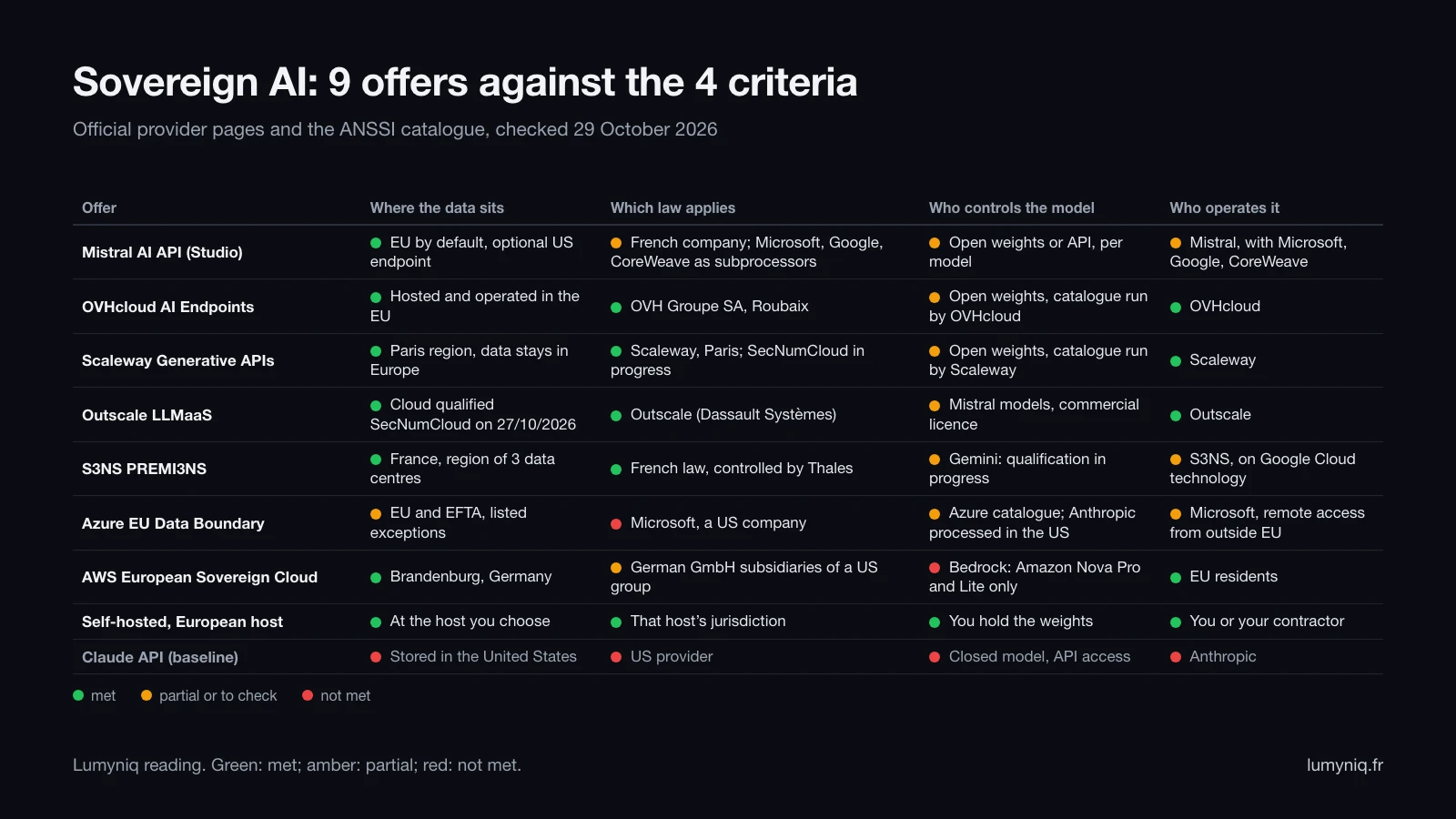
| Offer | Where the data sits | Which law applies | Who controls the model | Who operates it | Page read |
|---|---|---|---|---|---|
| Mistral AI API (Studio) | EU by default; US endpoint if you choose it | French company; US subprocessors Microsoft (Vibe, Studio/API), Google (Vibe, US endpoint) and CoreWeave (inference) | Apache 2.0 for Mistral Small 4 and Ministral 3; “Mistral Ecosystem Open Weight License” for Large 4; “Premier” for others | Mistral, with Mistral Compute (France), Microsoft (Sweden, Norway), CoreWeave (EEA), Google (Netherlands, Belgium, United States) | Help centre (12 Aug 2026), Trust Center and model docs (1 Nov 2026) |
| OVHcloud AI Endpoints | Hosted and operated in the European Union, per the page | OVH Groupe SA, Roubaix | 20+ open-weight models (incl. gpt-oss-120b, Qwen3.5-397B); OVHcloud decides the catalogue | OVHcloud; data not used for training, per the page | AI Endpoints page and catalogue |
| Scaleway Generative APIs | Paris region; data “only in Europe” | Scaleway, Paris; SecNumCloud offer in qualification | Open-weight models (gpt-oss-120b, Mistral Medium 3.5, Qwen, Llama); Scaleway decides the catalogue | Scaleway; does not read or reuse requests, per the page | Generative APIs page, ANSSI list |
| Outscale LLMaaS | Outscale cloud qualified SecNumCloud as of 27 October 2026 (IaaS until 30/11/2026) | Outscale, a Dassault Systèmes brand | Mistral commercial models (Medium, Small, Codestral, Embed, Voxtral) | Outscale; price on request | LLMaaS page, ANSSI catalogue |
| S3NS PREMI3NS | France, a region of 3 data centres | S3NS, French law, “fully controlled by Thales” | Gemini platform “in qualification” | S3NS, on Google Cloud technology | PREMI3NS page, ANSSI catalogue |
| Azure EU Data Boundary | EU and EFTA, with listed transfers (security, support, remote access) | Microsoft, a US company | Azure catalogue models; Anthropic models processed in the US | Microsoft; remote access from outside the EU possible | Microsoft Learn (21 July and 30 March 2026) |
| AWS European Sovereign Cloud | Brandenburg, Germany | European parent and three German GmbHs, Amazon group | Bedrock in this region: Amazon Nova Pro and Nova Lite | EU residents | January 2026 press release, aws.eu FAQ, Bedrock model page |
| Self-hosted open-weight model at a European host | At the host you choose (e.g. Scaleway PAR-1) | That host’s jurisdiction | You hold the weights; read the licence model by model | You or your contractor | Scaleway GPU prices, Mistral docs |
| Claude API (baseline) | Workspace geo: “us” is the only value; inference “us” or “global” | US provider | Closed model, API access | Anthropic | Anthropic data residency docs |
On model control, open weights served by a host stay portable, and the catalogue belongs to the host: OVHcloud’s marks Mistral-Small-3.2-24B as being retired, with an end of life on 4 November 2026. Mistral itself marked Mistral Medium 3.5 and Mistral Large 3 as deprecated on 31 October 2026, with retirement planned for 30 April 2027. Because the weights stay public, a fallback host can be planned at design time.
Two more readings. First, six of the eight commercial offers we checked state storage in Europe or France on their page (Mistral, OVHcloud, Scaleway, S3NS, Azure, AWS), which makes it the least useful criterion for telling offers apart. Second, in our reading, the criterion that really separates them is governing law, and you find it in the subprocessor list, rarely on the sales page.
We gave no overall score. A business that handles quotes does not face the same constraints as a clinic that handles patient files, and a single score would hide the criterion that matters to each of them.
The most quoted case
Is Mistral AI sovereign?
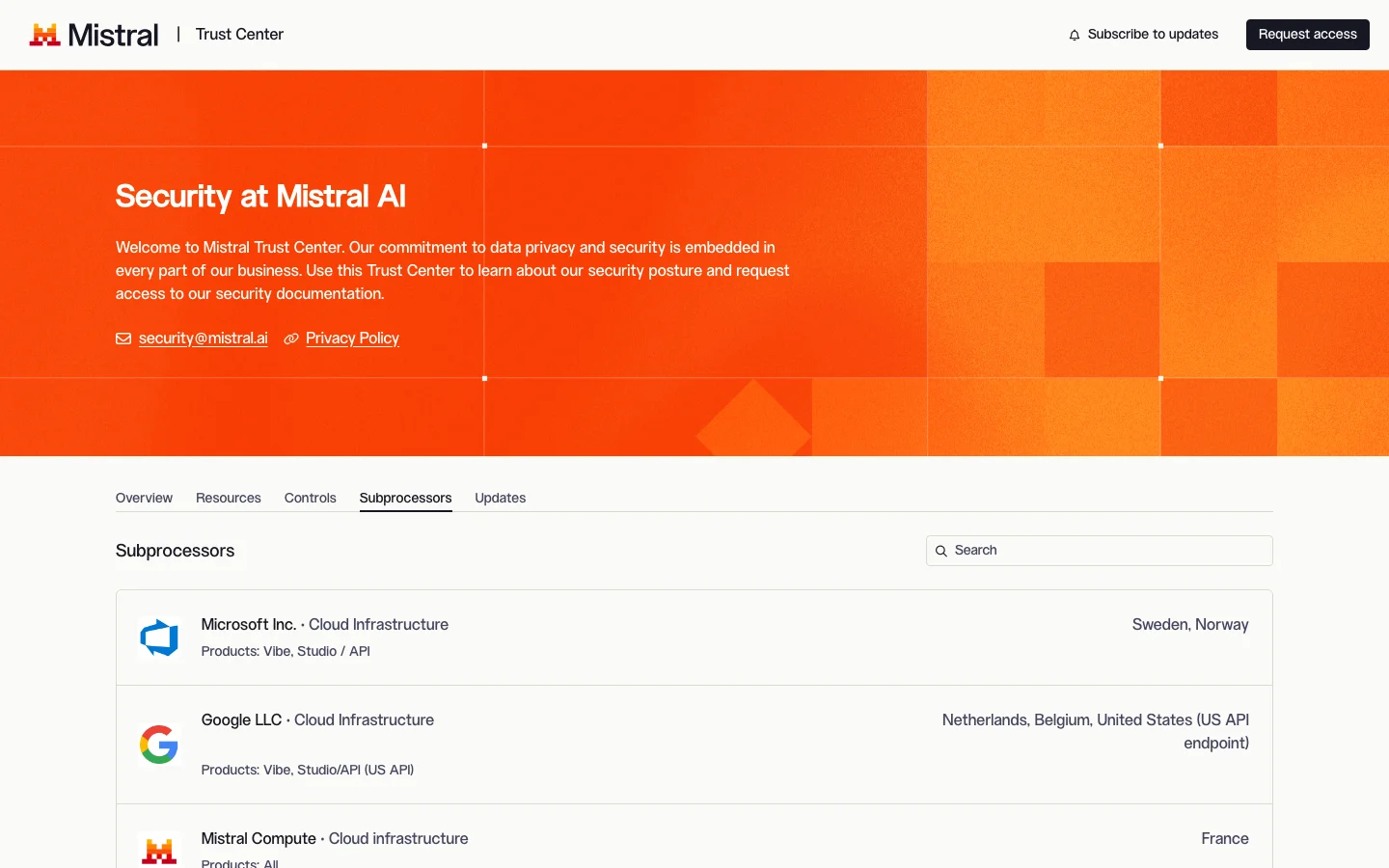
Mistral’s help centre (article updated 12 August 2026) says data is hosted in the European Union by default, in the United States if you use the US endpoint, and that it can be temporarily transferred outside the EU depending on the features used, to the locations listed under “Subprocessors”. Enterprise customers can switch off some of those features at organisation level.
Four lines on that list deserve a small business’s attention. Microsoft provides infrastructure for Vibe and Studio/API, in Sweden and Norway. Google provides infrastructure for Vibe and the US API endpoint, in the Netherlands, Belgium and the United States. CoreWeave Inc., whose website gives an address in Livingston, New Jersey, handles inference for all SaaS products, located in the EEA. Brave Software, in the United States, serves web search in Vibe and Studio/API: in our reading of that list, a team that turns on web search in an agent therefore sends the query across the Atlantic. The list also names Mistral Compute, in France, for all products.
On models, Mistral’s documentation, re-read on 1 November 2026, shows Apache 2.0 for Mistral Small 4 and the Ministral 3 family, the “Mistral Ecosystem Open Weight License” for Mistral Large 4, and a “Premier” label for several OCR, embedding and transcription models. The FAQ on its pricing page states that commercial deployments require a Mistral licence. The two pages do not say the same thing: read the card of the exact model before building a product on it.
To take US subprocessors out of the picture, there are three routes. Mistral says Enterprise customers can deploy Vibe on premises, in a private cloud or on Mistral Cloud. Outscale serves Mistral’s commercial models on its cloud, SecNumCloud qualified as of 27 October 2026. Scaleway and OVHcloud serve open-weight Mistral models. The Trust Center also lists ISO 27001, ISO 27701 and SOC 2 Type II for Mistral AI.
The primary source
What the ANSSI SecNumCloud list actually says
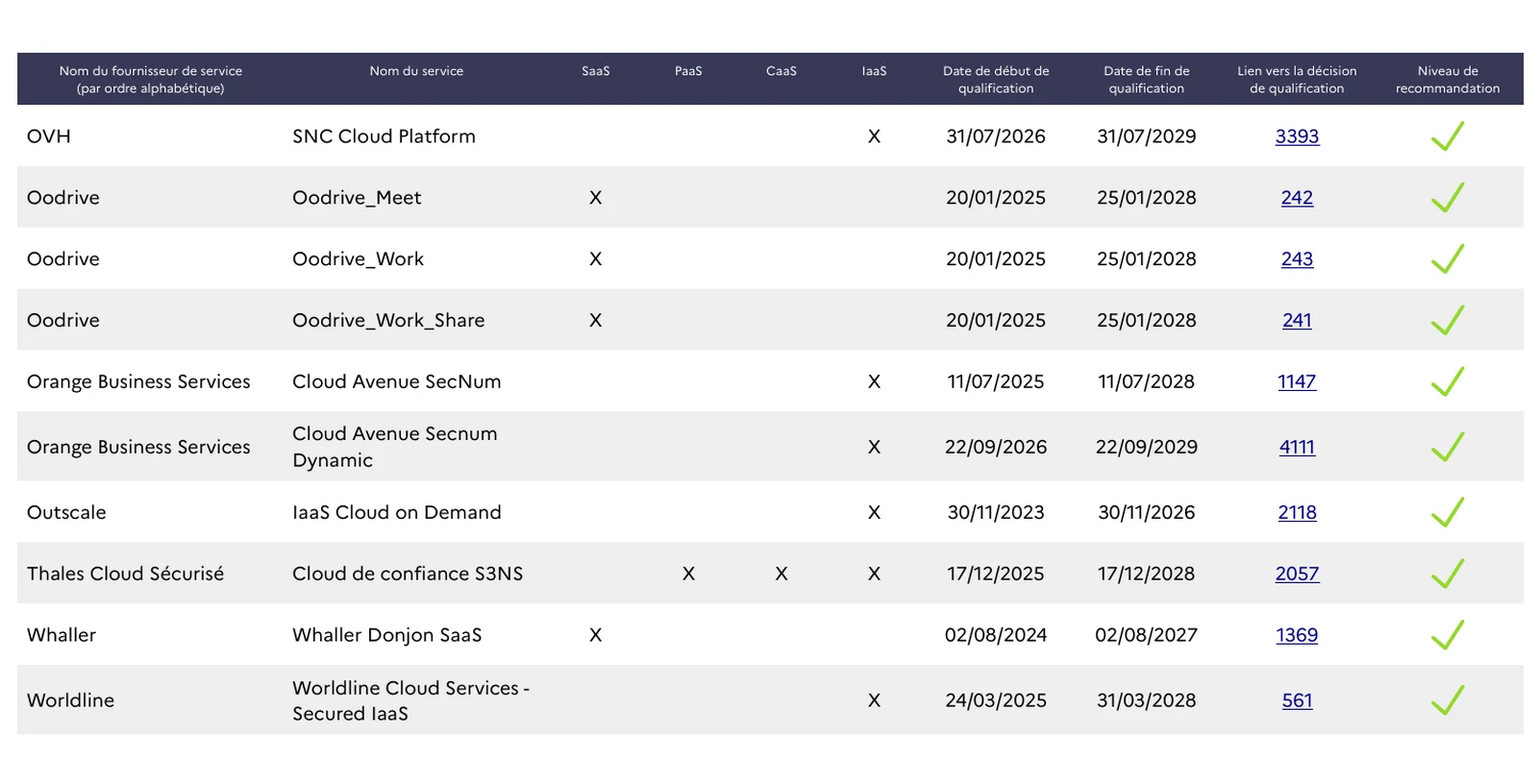
We read section 3.3 of the catalogue line by line. The qualified infrastructure offers that could host a model are those of Cegedim, Cloud Temple, Ecritel, Numspot, OVH (Hosted Private Cloud, Bare Metal Pod, SNC Cloud Platform), Orange Business Services, Outscale, Thales Cloud Sécurisé for S3NS, and Worldline. The other lines cover software such as Wimi, Oodrive, Pronote or Whaller.
| Provider and service | Type | Qualified from | Until |
|---|---|---|---|
| Outscale, IaaS Cloud on Demand | IaaS | 30/11/2023 | 30/11/2026 |
| OVH, Hosted Private Cloud powered by VMware | IaaS | 28/12/2023 | 29/12/2026 |
| OVH, Bare Metal Pod | IaaS | 24/03/2025 | 24/03/2028 |
| OVH, SNC Cloud Platform | IaaS | 31/07/2026 | 31/07/2029 |
| Thales Cloud Sécurisé, Cloud de confiance S3NS | PaaS, CaaS, IaaS | 17/12/2025 | 17/12/2028 |
| Numspot, cloud services platform | IaaS | 31/07/2026 | 31/07/2029 |
| Cloud Temple, Secure Temple | IaaS | 31/07/2026 | 30/05/2028 |
Three findings follow. Outscale’s qualification, the base of its LLMaaS offer with Mistral, expires on 30 November 2026, and OVH’s Hosted Private Cloud on 29 December 2026: if a contract requires SecNumCloud, ask for a valid certificate at signature. Next, Scaleway (“Scaleway SecNumCloud”, IaaS and PaaS) and Bleu (IaaS, PaaS, CaaS) appear on the ANSSI page of providers in qualification, and an offer in qualification is not qualified. Finally, S3NS is qualified for its trusted cloud and states that its Gemini platform is still in qualification.
In our reading, a private small business rarely needs SecNumCloud: the requirement comes from a client, a public buyer or a regulated sector. When it appears in a tender, it applies to the infrastructure that runs the model, the logs and the conversation storage.
Microsoft, AWS, Google
The big clouds’ European data boundaries: what they change
Microsoft EU Data Boundary
Microsoft commits to storing and processing customer data for Azure, Dynamics 365, Power Platform and Microsoft 365 in the EU and EFTA (Microsoft Learn page updated 21 July 2026). The page listing the exceptions, updated 30 March 2026, describes remote access by staff outside the EU, which Microsoft itself treats as a transfer under European privacy law, security operations that consolidate pseudonymised data mainly in the United States, and one line that matters directly for AI: when a customer allows Anthropic models in Microsoft’s generative AI services, customer data is processed by Anthropic in the United States, while remaining stored in the EU Data Boundary.
AWS European Sovereign Cloud
In January 2026 AWS announced general availability of its European Sovereign Cloud, with a first region in Brandenburg, Germany, operated exclusively by EU residents, under a new parent company with three German subsidiaries within the Amazon group. Existing AWS accounts do not work in this separate cloud. For AI, the AWS page on Bedrock models by Region lists only Amazon Nova Pro and Nova Lite in eusc-de-east-1, with in-Region inference. The Anthropic, Mistral or Meta models offered elsewhere on Bedrock are not there as of 29 October 2026.
Google Cloud Data Boundary and S3NS
Google offers three European packages in Assured Workloads (page updated 26 October 2026): “EU Data Boundary”, free, which restricts data location to EU regions; “EU Data Boundary and Support”, paid, which limits support to EU-based staff; and a version with Access Justifications. In France, S3NS runs an offer built on Google Cloud technology, under French law and controlled by Thales, which ANSSI lists as SecNumCloud qualified.
Our reading: for a business already on Microsoft 365 or AWS, these offers require the fewest changes. They fit levels 0 and 1 of the grid below. They do not meet a “no party subject to US law” requirement, which only European providers or self-hosting can meet.
The most controlled route
Self-hosted AI: running an open-weight model yourself
On 29 October 2026 Scaleway’s price list shows the L4-1-24G instance at €0.79 an hour and a monthly figure of about €574.87 running continuously, as displayed by Scaleway, in the PAR-1 zone. H100 instances are only offered in PAR-2. By our calculation, gpt-oss-120b, published in fp4 with 117 billion parameters according to OVHcloud’s catalogue, takes about 58 GB for its weights alone, more than twice a 24 GB card: such a model needs several cards.
We do not repeat the full analysis here: our guide to self-hosted AI agents and what stays with you separates orchestration, model and data, and shows why a self-hosted n8n calling an external API is not self-hosted AI.
The maths
What sovereignty costs, in euros and in quality
Our assumption, written out so you can redo it: 2,000 requests a month, 10,000 input tokens and 1,000 output tokens per request, so 20 million input tokens and 2 million output tokens. Public list prices shown on 29 October 2026, without discounts or caching; Mistral Large 4 re-read on 1 November 2026.
| Offer and model | Input / output price per million tokens | Monthly cost | Criteria met |
|---|---|---|---|
| OVHcloud AI Endpoints, gpt-oss-120b | €0.08 / €0.40 | €2.40 | EU storage, French law, open weights |
| Scaleway Generative APIs, gpt-oss-120b | €0.15 / €0.60 | €4.20 | Paris storage, French law, open weights |
| Scaleway Generative APIs, qwen3.5-397b-a17b | €0.60 / €3.60 | €19.20 | Same |
| Scaleway Generative APIs, mistral-medium-3.5-128b | €1.50 / €7.50 | €45.00 | Same |
| Mistral API, Mistral Medium 3.5 (price list of 29 October, deprecated 31 October 2026) | $1.50 / $7.50 | $45.00 | EU storage, French company, US subprocessors |
| Mistral API, Mistral Large 4 (price list of 1 November 2026) | $0.70 / $2.10 | $18.20 | Same |
| Anthropic API, Claude Sonnet 5.5 | $2 / $10 | $60.00 | None of the four |
| Anthropic API, Claude Opus 5.5 | $4 / $20 | $120.00 | None of the four |
| Scaleway, self-hosted L4-1-24G GPU | €0.79 an hour | ~€574.87 as displayed, fixed | All four at a European host; small models on one card |
Two notes on this table. The same model, gpt-oss-120b, costs almost twice as much at Scaleway as at OVHcloud, so compare price lists before choosing a host. And on 29 October 2026, Mistral Medium 3.5 showed the same amounts at Scaleway, in euros, and on Mistral’s API, in dollars; the real gap depends on the exchange rate on the invoice date. By 1 November 2026 Mistral no longer listed it on its price list: it has been deprecated since 31 October, with Mistral Large 4 as the replacement according to its documentation.
We publish no quality comparison: no public benchmark measures your tasks. Test two or three models on twenty real cases from your business before deciding. That test shows whether an open-weight model is enough for your tasks.
Decision grid
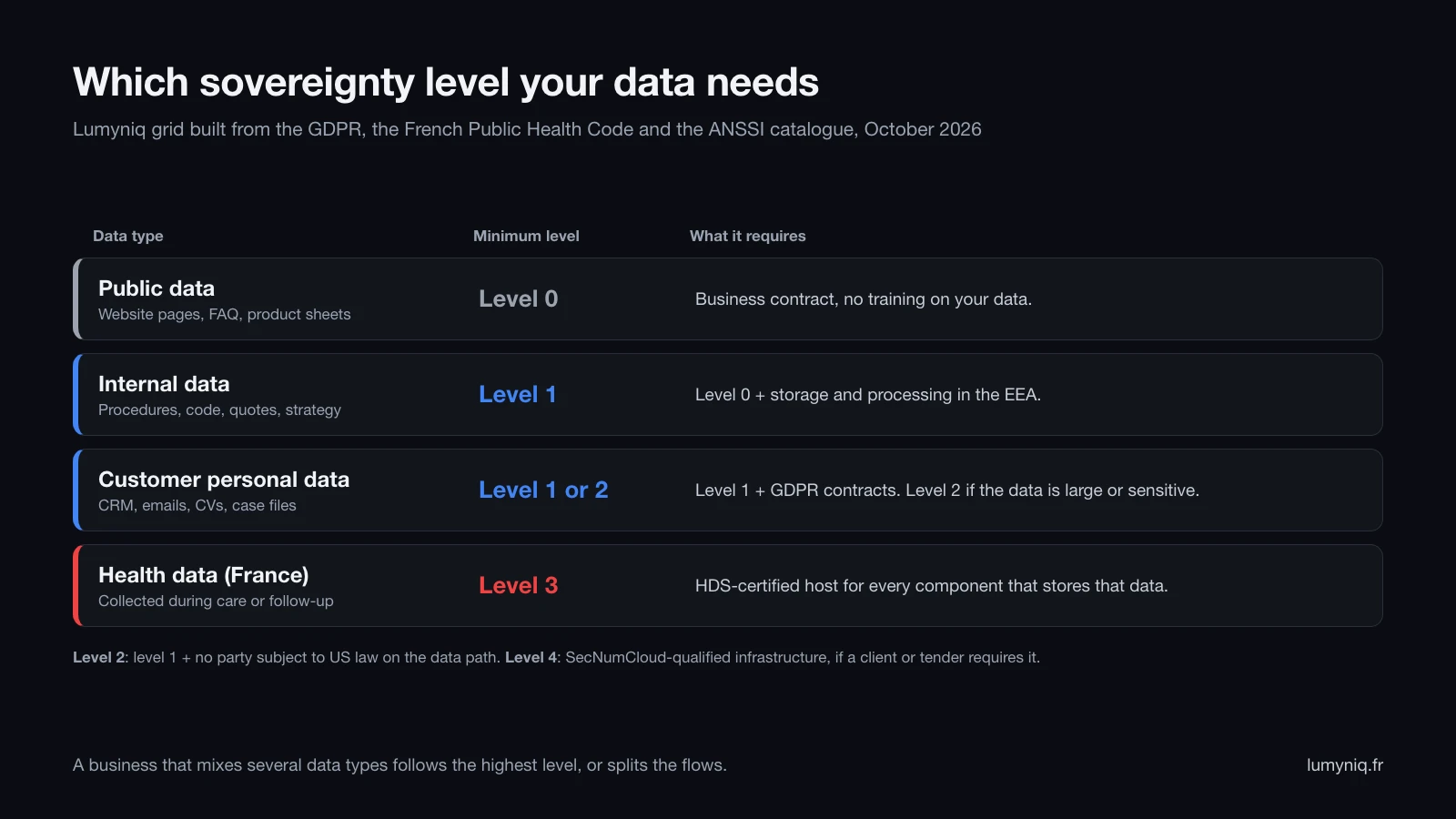
Which sovereignty level for which type of data
| Level | What it requires | Offers in our survey that meet it |
|---|---|---|
| 0 | Business contract, no training on your data | All of them, on a business plan or API |
| 1 | Level 0 + storage and processing in the EEA | Mistral, OVHcloud, Scaleway, Outscale, S3NS, Azure EU Data Boundary (EU and EFTA, excluding Anthropic models), AWS European Sovereign Cloud |
| 2 | Level 1 + no party subject to US law on the data path | OVHcloud, Scaleway, Outscale, S3NS, self-hosting at a European host |
| 3 | HDS-certified host for every component that stores health data collected during prevention, diagnosis, care or social and medico-social follow-up (France) | Check offer by offer: see our HDS guide |
| 4 | SecNumCloud-qualified infrastructure | Outscale (IaaS qualified until 30/11/2026, LLMaaS not qualified as such), S3NS (Gemini in qualification); outside our survey: OVH SNC Cloud Platform and the other IaaS in the catalogue |
In our reading, level 2 depends on configuration. At OVHcloud and Scaleway it holds as long as you do not plug a US tool into the agent (web search, observability, CRM). For health data in France, the scope of Article L.1111-8 of the Public Health Code, the EU and EEA storage rule and cloud coverage are covered in our guide to AI agents and health data.
One option is to split the flows: a closed US model for drafting from public data, an open-weight model served in Europe for anything that touches customers. That is the kind of architecture we design for a custom AI agent, with the data sorted before the models are chosen. If the topic is new to you, our guide to what an AI agent is, with business examples covers the basics.
EU law
What the GDPR and the AI Act actually say
GDPR. Article 28 requires you to use only processors that provide sufficient guarantees, and bars a processor from engaging another without your written authorisation. In our reading, your AI provider’s subprocessor list therefore matters as much as its sales page. Article 44 subjects any transfer to a third country to the conditions of Chapter V. The CNIL’s page on transfers, accessed 29 October 2026, recalls the adequacy decision of 10 July 2023 for the United States, which covers certified companies.
AI Act. We found no localisation requirement in Regulation (EU) 2024/1689. For a business deploying an assistant or an agent, the most common duty is Article 50: tell people they are interacting with an AI system, at the latest at the first interaction. Article 4, softened by the Digital Omnibus, asks deployers to take measures to support the AI literacy of their staff. Article 53(2) exempts providers of models released under a free and open licence from some documentation duties, except for models with systemic risk. That exemption is for the model provider; your business keeps its deployer duties. The full timeline is in our AI Act guide for businesses.
Choosing sovereign AI therefore exempts you from none of these. The records of processing, the processor contract, the impact assessment where required and user information all remain, at Mistral as at Anthropic.
Limits
What sovereignty does not fix
- Agent security. Access rights, logs and injection resistance are settled in the design, whoever hosts the model. Our guide to AI agent security covers them.
- Connected tools. A model served in Paris wired to a US CRM, analytics tool or web search sends data out through the tool.
- Validity dates. Every qualification in the ANSSI catalogue carries an end date, and two offers named here expire before the end of 2026. A sales page can show a qualification the catalogue no longer carries.
- Quality. If your test shows an open-weight model is not enough for a task, the question becomes which data to send to the closed model, and how to reduce it. Our comparison of Claude, ChatGPT and Mistral for business covers that choice.
- The law. This page reads official pages as of 29 October 2026, Mistral re-read on 1 November 2026, and is not legal advice. Have your analysis checked by your DPO or a lawyer.
If you are torn between levels, a short audit can settle it: inventory of the data the AI will see, a test of two models on your cases, a read of the subprocessors. That is the format of our AI consulting engagement. Lumyniq is an agency: we do not sell self-service software, every project has a set-up time and a budget agreed after the audit.
FAQ